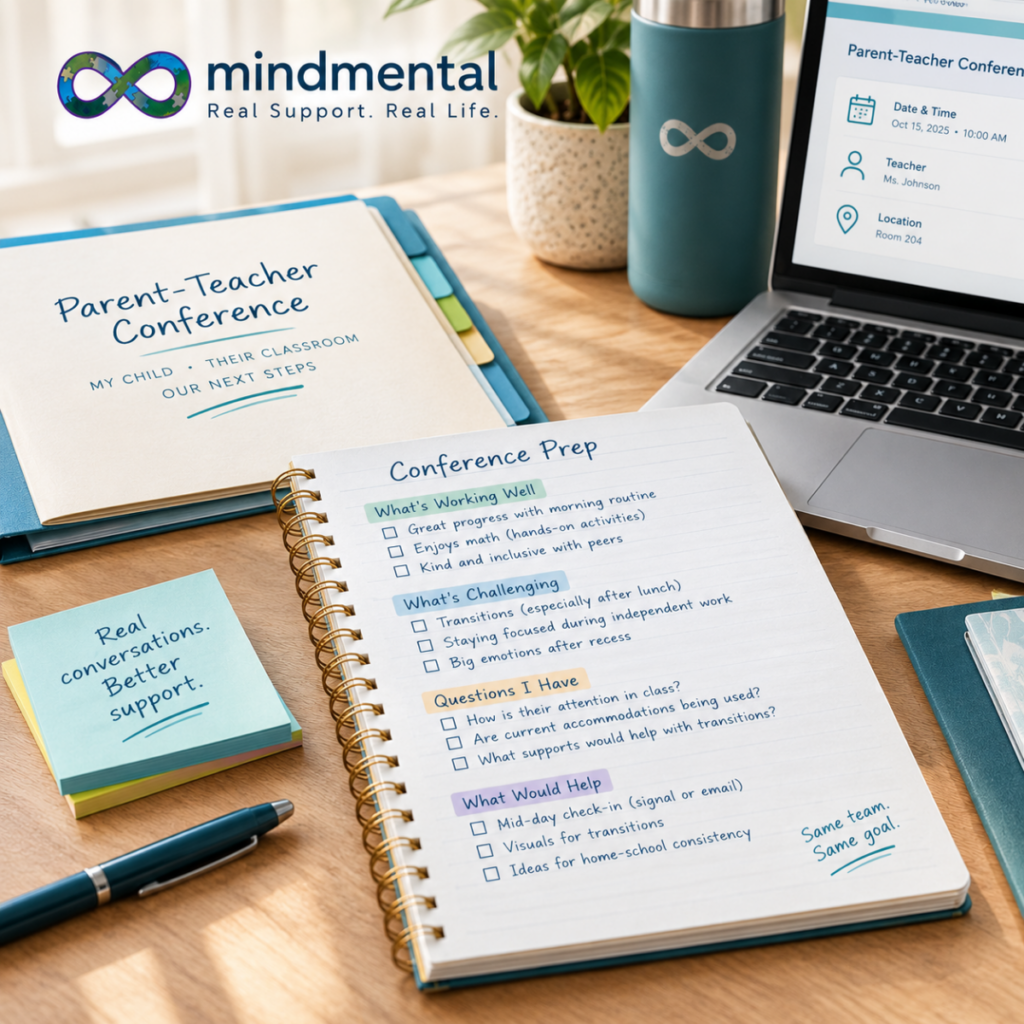
A month in, you have real information about how the year is going. Conferences are the first place you’ll be asked to say it out loud.
A month in, you finally have real information about how the year is actually going. Conferences are the first place you’ll be asked to say it out loud, to someone who’s forming their own picture of the same child at the same time, often in a 30-minute window that isn’t built for either of you to say everything you actually know.
If you reached out early in August, sent a brief note about what matters most, led with strengths, stayed available in those first weeks, you’re not walking in from zero. You’re walking in to build on something that already started. If that didn’t happen, or didn’t happen the way you wanted, this conversation is still a real chance to start now.
Either way, the thirty minutes go better with a plan than without one.
What a Teacher Already Knows, and What They Don’t
By conference time, a teacher has roughly a month of direct observation. That’s real information, but it’s also incomplete in specific ways. They’ve seen how your child performs in a classroom of twenty-five kids, under classroom lighting, on a classroom schedule. They likely haven’t seen how your child does at 6 PM after a full day of holding it together. They haven’t seen the version of your child that shows up after a hard drop-off, or the specific thing that helps them recover from a rough moment at home.
You know that half of the picture. They know the half you don’t get to see. Conferences work best when both halves actually get shared, rather than one side mostly listening while the other mostly reports.
What to Bring
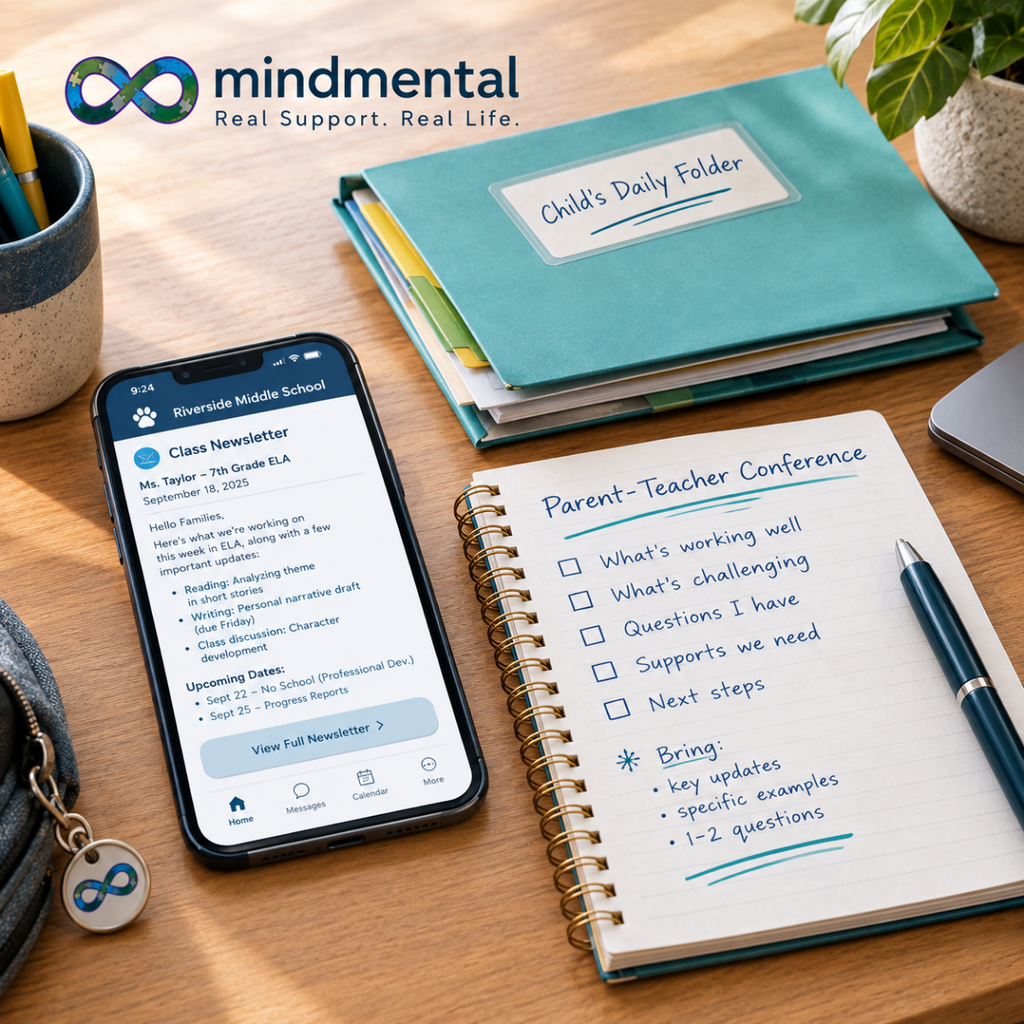
Not a file. Not a folder of everything from the IEP. A short list, three or four things, said plainly.
What’s actually working right now. Not a general “they’re doing okay,” but something specific enough to be useful. A particular accommodation that’s making a visible difference. A strategy from last year that carried over well. A behavior at home that’s genuinely improved since school started.
What’s not working, described by pattern, not just by incident. One hard day isn’t a pattern. If the same kind of hard moment has shown up more than once, that’s worth naming, specifically enough that the teacher can start watching for it too, rather than filing it away as one bad afternoon.
One question you actually want answered. Not “how are they doing,” which invites a general answer. Something closer to “what does it look like right before a shutdown happens in your classroom,” or “is the accommodation from the IEP actually being used day to day, and if not, what’s getting in the way.” A specific question gets a specific answer, and a specific answer is what makes the thirty minutes worth having.
What would help you help them. If there’s a way for the teacher to flag something in real time, a quick email, a shared note, a simple signal, this is the moment to ask for it, rather than waiting for the next crisis to bring it up for the first time.
For Older Kids and Teens: A Different Kind of Gap
Everything above assumes a child who’s still young enough that a parent and teacher are the two people naturally holding the full picture together. For older kids and teens, conferences run into a different problem entirely.
Middle and high school are built around growing independence. Kids move between multiple teachers instead of one. They’re expected to advocate for themselves, ask for help when they need it, and find the right adult when something isn’t working. That expectation is developmentally appropriate for a lot of teens. For a teen who struggles to identify what they need in the moment, who freezes rather than raises a hand, who doesn’t know which of six teachers to actually go to, or who has learned that asking for help hasn’t gone well in the past, that same expectation can quietly become a gap nobody notices until it’s already wide.
The system isn’t failing on purpose here. It’s built around an assumption, that a student who needs something will say so, that mostly holds for a lot of kids and doesn’t hold at all for others.
A few things worth naming at a conference if this sounds like your teen:
Ask directly whether your teen has ever come to this teacher for help. Not “do they seem okay in class,” but literally whether your teen has initiated a conversation when something was wrong. The answer often tells you more than anything else discussed in the room.
Name that self-advocacy may not be automatic yet, without framing it as a deficit. Something like, “I want to make sure it’s clear he can come to you, because reaching out first isn’t something that comes easily to him yet,” gives a teacher permission to check in proactively rather than waiting for a request that may never come.
Ask who the actual point of contact is when something comes up mid-day. With six different teachers and no single homeroom adult holding the whole picture, it’s worth asking plainly who a teen is supposed to go to if something happens in a class that isn’t this one, and whether that person actually knows to expect it.
Consider whether your teen needs a standing check-in, not just an open door. An open door only works for a kid who knows how to walk through it. A five-minute standing check-in, even once a week, with one adult who already knows the context, can catch what an open-ended “come find me if you need anything” never will.
Older kids don’t need less advocacy. They need a different kind, one that accounts for the specific skill of asking for help, which some kids build early and some kids are still building well into their teens.
If August Didn’t Go the Way You Hoped
Maybe the early outreach didn’t happen. Maybe it did, and it didn’t land the way you wanted. Maybe this is a teacher who still doesn’t seem to fully see your child a month in.
That doesn’t mean conferences are a loss. It means this conversation carries a little more weight than it might for a family who’s already built some trust. Leading with something the teacher is doing well, even something small, tends to open the conversation more than leading with everything that’s gone wrong so far. Trust that didn’t start in August can still start in October. It just has fewer weeks behind it than you might have wanted.
When the Conversation Goes Sideways
Sometimes a conference doesn’t go the way it was supposed to. A concern gets minimized. A tone shifts defensive. Thirty minutes turns into twenty, with half of what you wanted to say still unsaid.
If that happens, you don’t have to resolve everything in the room. A few things that help more than pushing harder in the moment:
Ask for a follow-up, specifically, before the conversation ends. “Can we set up a quick call in two weeks to check on this” keeps the thread open rather than letting it end on a note that felt unfinished.
Write down what was actually said, while it’s fresh, not what you wish had been said. This matters if the conversation needs to be referenced again later, and it matters just as much for your own clarity about what actually happened versus what it felt like in the moment.
Give it a day before deciding what it means. A conference that felt dismissive in the room sometimes reads differently once the adrenaline of the conversation itself has worn off. Not always, but often enough that it’s worth waiting a day before deciding whether this was a bad five minutes or a real pattern worth escalating.
The Non-Obvious Insight
Conferences aren’t a test of whether the year is going well. They’re one data point, gathered from a thirty-minute window, by two people who each know something the other doesn’t, and for older kids, sometimes a third person who hasn’t yet learned how to say what they need at all.
The conversation works best when it’s treated as an exchange, not a report card. You’re not there to receive a verdict, and the teacher isn’t there to deliver one. You’re both trying to build a slightly more complete picture of the same child, using the piece only you have and the piece only they have, and for teens, actively checking whether anyone is holding the piece that depends on your child asking for it first.
Thirty minutes isn’t much time to do all of that. But it’s more than enough time to walk in with three specific things to say, and walk out with one clear next step, if that’s what you actually bring to it.
School-Related Posts
Did you miss last week’s article? Read about the first month of school HERE
Let’s Connect
Email: hello@mindmental.co
Newsletter: Sign up to receive monthly highlights and resources Blog: New posts weekly
I am not a licensed therapist or counselor and do not provide clinical mental health services. Mindmental offers educational resources, organizational tools, and community support based on professional and lived experience. For clinical care, please contact a licensed provider.