
You expected school to give you some of your time back. A month in, here’s an honest look at where it actually went, and how to find some of it again.
Somewhere in the last week of summer, a lot of parents made a quiet promise to themselves.
Once school starts, I’ll have my mornings back.
Once there’s a routine, evenings will feel calmer.
Once the kids are occupied for seven hours a day, I’ll finally catch up.
One month in, many parents are looking at their calendars wondering where that time actually went.
This isn’t necessarily a failure of planning.
It’s often a mismatch between the amount of time we expected the school routine to return and the amount of time the school year actually makes available.
And naming that mismatch honestly is the first step toward doing something useful with the time that is available, instead of continuing to plan around time that never really came back.
What the Time You Expected
The expectation usually sounds something like this:
School starts. The kids are out of the house on a predictable schedule. The hours that went toward entertaining, supervising, managing, or simply being available to them all summer are returned to the parent.
There will be time for errands during school hours.
A quieter house.
Maybe even enough time to sit down before the afternoon pickup begins.
For some families, some of that does happen.
But it is rarely the full return people picture in August.
Because the school year doesn’t simply remove summer responsibilities.
It replaces some of them with different ones.
Where the Time Actually Goes
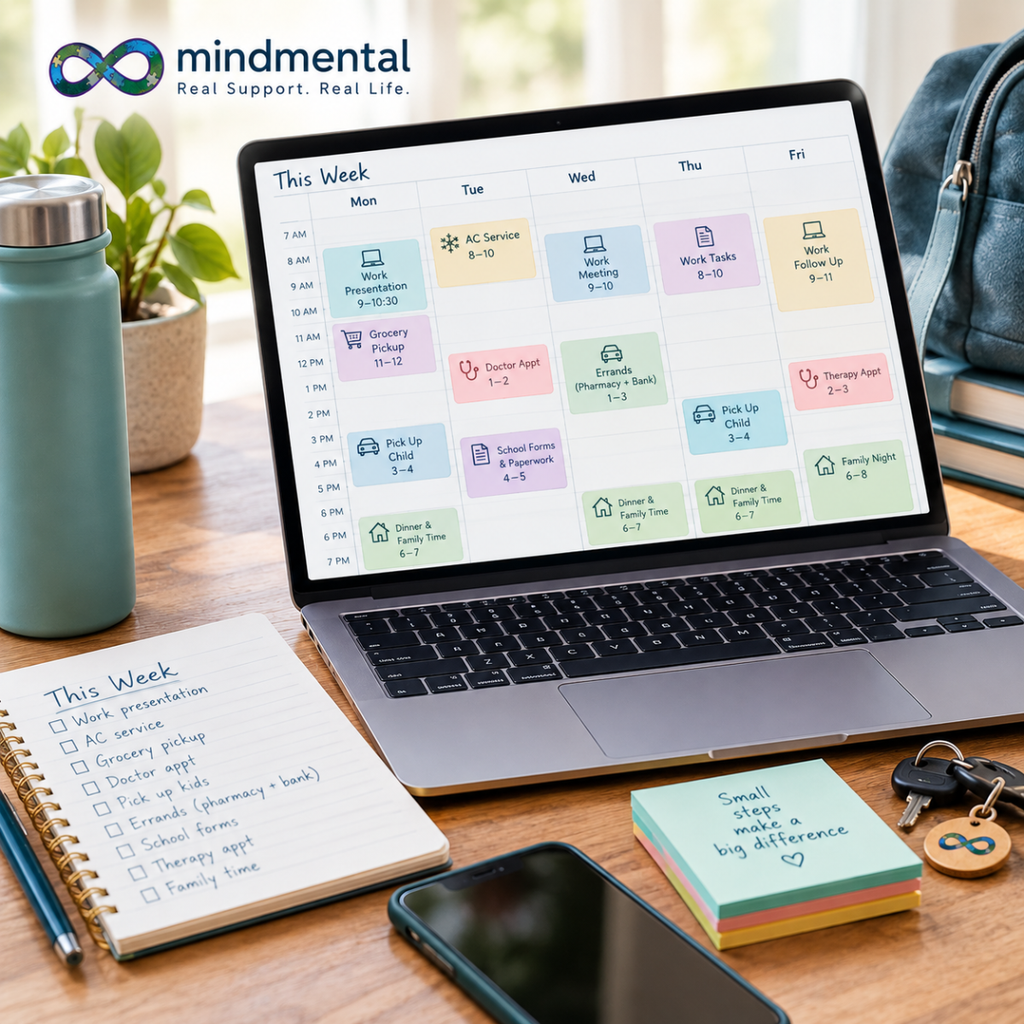
A month into the school year, the calendar can look different than expected, not necessarily because it is filled with the same things, but because it is filled with new things that weren’t part of the summer routine at all.
Homework help lands somewhere in the evening, often at exactly the time everyone has the least capacity left.
Back-to-school paperwork, forms, sign-ups, supply requests, and school communications keep arriving in waves.
After-school activities start up, adding pickup times, driving, and transitions that summer didn’t require.
And then there are the less visible demands.
A teacher email that needs a response.
A difficult drop-off that needs to be processed.
A child who comes home overwhelmed and needs time before they can do anything else.
Early signs that something about the school year isn’t working quite right, and the mental energy required to figure out what to do next.
None of this means the time disappeared.
It changed shape.
The hours that used to go toward summer supervision may now be going toward school-year logistics, transportation, homework support, emotional processing, and planning.
And logistics rarely announce themselves as clearly as watching the kids did.
A Quick Check-In
Before moving into what to actually do about this, pause for a moment and look at where things stand now, not where you expected to be in August.
Compared with what you expected one month ago, is your time:
☐ About what I expected
☐ Different, but manageable
☐ Noticeably tighter than I planned for
☐ I’m not sure where it’s going, it just feels gone
What’s actually filling the hours you thought you would get back?
☐ Homework and schoolwork support
☐ Logistics, paperwork, forms, and scheduling
☐ New activities and transportation
☐ Processing how the year is going, emotionally or practically
☐ Something else entirely
There is no right answer.
The point isn’t to judge how you’re using your time.
It’s to see the actual shape of your month rather than continuing to compare it with the imagined version from August.
Finding Time Inside the Reality, Not Around It
Once the actual shape of the month is visible, the more useful question isn’t:
How do I get back to the August version of my schedule?
Where, inside this actual routine, might a little more room exist?
Look for logistics that can be batched.
Paperwork, sign-ups, forms, and school communications tend to arrive steadily rather than all at once. That doesn’t mean they each need their own interruption.
Try creating one small weekly window, even fifteen minutes, to handle what has accumulated.
The goal isn’t to create another elaborate productivity system.
It’s to stop small administrative tasks from taking tiny pieces of your attention all week.
Separate homework help from homework presence.
Not every assignment requires a parent sitting beside a child from beginning to end.
For some children, being nearby while they work independently and available when they genuinely get stuck may be enough.
That can look different depending on the child’s age, learning needs, and current capacity, but the distinction matters.
Supporting homework doesn’t always mean supervising every minute of it.
When appropriate, creating a little more independence can return some time to the parent without removing support from the child.
Revisit activities against actual capacity.
An activity that seemed completely reasonable during August sign-up season can look very different once it is competing with homework, dinner, transportation, bedtime, and everyone’s actual end-of-day energy. That doesn’t mean the activity was a bad decision. It means you have more information now.
It’s okay to revisit a commitment a month into the school year and ask whether it still fits the family you actually are right now. You don’t have to wait until the next semester, or until everyone is completely depleted, to make an adjustment.
Let some logistics happen during in-between moments.
Not every administrative task needs a dedicated block of time. Checking a school portal, responding to a quick message, confirming an appointment, or reviewing a form may fit into a car line, waiting room, or five-minute gap between activities. That doesn’t mean every spare moment should become productive time. It means some tasks don’t need to consume the larger blocks of time that could be used for something that actually requires your attention.
Name the emotional processing time.
This one is easy to miss because it often doesn’t appear anywhere on the calendar. Thinking about a difficult drop-off. Wondering whether your child is adjusting. Planning what to say to a teacher. Replaying something that happened during the school day. Figuring out whether a new behavior is a passing transition or something that needs more attention.
That is time, even though it may not look like a task. It still takes mental and emotional capacity. Naming it doesn’t make the concern disappear, but it makes the invisible load visible, and that can make it easier to stop expecting your remaining free time to function like completely unused space.
The Non-Obvious Insight
The time didn’t necessarily vanish. It relocated.
Summer supervision became school-year logistics. Open mornings became errands, appointments, paperwork, or work. Unstructured afternoons became transportation and activities. Some of the mental space that felt available in August became occupied by thinking about how the school year is going.
That’s an important distinction, because if you believe your time disappeared, the natural response is to try to become more efficient.
If you recognize that your time changed shape, the question becomes different.
What can be simplified?
What can be batched?
What can be handed off?
What no longer needs to happen?
What actually deserves the limited capacity available right now?
You aren’t necessarily managing your month worse than you expected.
You’re managing a different month than the one you pictured in August.
Now that the real shape of it is visible, you have something much more useful than the August plan.
You have actual information.
And from there, you can start making decisions based on the life your family is actually living, not the one you thought the school calendar would create.
School-Related Posts
- 5 Things Every Parent Should Know About IEP Meetings
- When Teachers Say “I’m Already Doing That”: What It Really Means
- Support Without Labels: A Framework for Talking About Accommodations
- When “Wait and See” Means “Wait and Struggle“
Let’s Connect
Email: hello@mindmental.co
Newsletter: Sign up to receive monthly highlights and resources Blog: New posts weekly
I am not a licensed therapist or counselor and do not provide clinical mental health services. Mindmental offers educational resources, organizational tools, and community support based on professional and lived experience. For clinical care, please contact a licensed provider.