When Teachers Say “I’m Already Doing That”: What It Really Means and What to Do About It
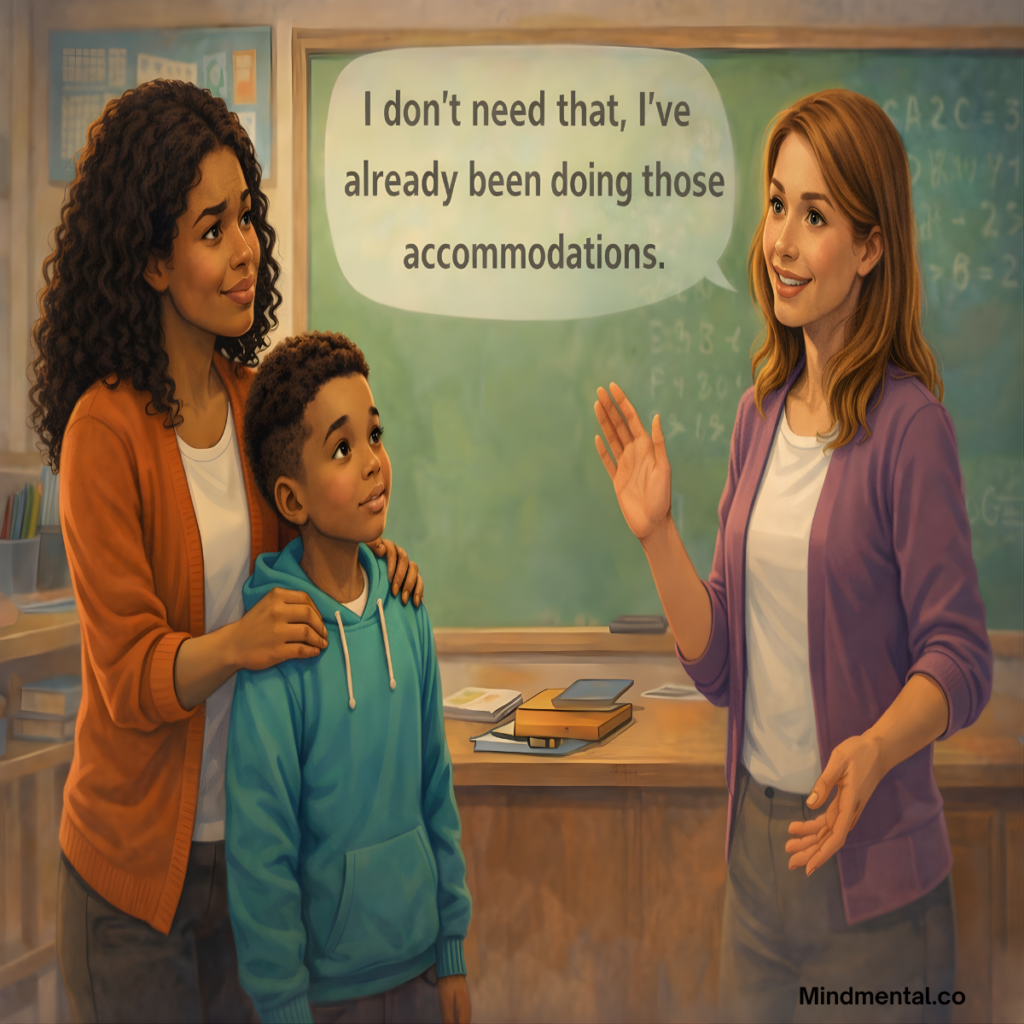
You’re sitting in an IEP meeting. You’ve come prepared – binder organized, data printed, accommodations researched. You ask for something your child needs. Extended time on tests. Preferential seating. Visual schedules. Breaking assignments into chunks.
And the teacher smiles kindly and says: “Oh, I’m already doing that for all my students.”
It sounds reassuring. Supportive, even. Like your child is already getting what they need, so why formalize it?
But here’s what that statement actually means – and why it’s a problem.
What “I’m Already Doing That” Really Means
When a teacher says they’re already providing an accommodation informally, they’re often telling the truth. Many good teachers differentiate instruction. They give extra time when students need it. They offer brain breaks. They check in with struggling kids.
But informal support is not the same as documented accommodations.
Here’s the difference:
Informal support:
- Happens when the teacher remembers
- Happens when the teacher has capacity
- Happens when the teacher thinks it’s needed
- Stops when your child gets a new teacher
- Disappears during substitutes, assemblies, testing days
- Isn’t tracked, measured, or consistent
Documented IEP/504 accommodations:
- Must happen every single time
- Are legally required
- Follow your child to every teacher, every year
- Are provided during state testing
- Can be enforced if not followed
- Create a paper trail of what works
“I’m already doing that” means: “I’m doing it when I can.” It does not mean: “Your child can rely on this.”
Why Teachers Resist Formalizing Accommodations
I don’t think most teachers are being difficult when they say this. I think they genuinely believe that if they’re already helping informally, putting it in writing is unnecessary paperwork.
But here’s what they may not realize:
Your child isn’t just in their classroom.
Your child will have different teachers next year. And the year after that. Your military family might PCS next summer. That informal support? It doesn’t transfer.
What gets documented gets delivered.
When an accommodation is written into an IEP or 504 plan, it’s not optional. It’s required. And that consistency—knowing it will happen in every class, every day, with every teacher – is what allows your child to succeed.
What to Say When You Hear “I’m Already Doing That”
You don’t have to be confrontational. You don’t have to accuse the teacher of anything. But you do need to advocate clearly.
Try this:
“I’m so glad to hear you’re already supporting [child’s name] that way. That tells me this accommodation is working and meeting their needs. Let’s make sure it’s documented in the IEP/504 so that every teacher, this year and in future years, knows to provide it consistently. Especially as a military family, we need to ensure these supports follow [child] if we PCS or change schools.”
What this does:
- Acknowledges the teacher’s effort
- Reframes documentation as continuity, not distrust
- Makes it about your child’s long-term needs, not just this classroom
- Reminds the team that military kids move—a lot
When “I’m Already Doing That” Becomes a Pattern
If you hear this repeatedly – across multiple accommodations, multiple teachers, or multiple meetings, it may be a sign that the team is trying to avoid putting things in writing.
Sometimes it’s about resources. Sometimes it’s about not wanting to “label” a child. Sometimes it’s about workload.
But here’s the hard truth: Your child’s needs don’t disappear because documentation feels inconvenient.
If the accommodation is already being provided and it’s working, there is no reason not to formalize it.
If the team resists, ask directly:
“If you’re already doing this successfully, what’s the concern with documenting it?”
Listen to the answer. Address the concern if you can. But stand firm on this: If it’s happening, it should be written down.
For Military Families: Why This Matters Even More
Military kids change schools an average of 6-9 times before graduation. Every move means:
- New teachers who don’t know your child
- New schools with different systems
- New IEP teams who didn’t see what worked before
Documented accommodations are the bridge.
When you PCS and hand over that IEP to a new school, those accommodations tell the next team: “This is what this child needs to succeed. This is what worked.”
Informal support doesn’t make the move. Documentation does.
What to Remember
Good teachers want to help. Most of them genuinely care about your child’s success.
But caring isn’t the same as accountability. And informal support isn’t the same as enforceable accommodations.
If it’s working, document it. If it’s needed, formalize it. If they’re already doing it, there’s no reason not to write it down.
Your child deserves consistency. Your child deserves reliability. Your child deserves supports that follow them; no matter which teacher they have, no matter which school they attend, no matter where the military sends your family next.
Don’t settle for “I’m already doing that.”
Ask for it in writing.
This Is Why MindMental Exists
At MindMental, we believe in support without shame and advocacy without apology.
Our kids aren’t asking for special treatment. They’re asking for the tools they need to access the same education every other child gets.
And if those tools are already being provided? Then documenting them should be the easiest yes in the room.
What’s your experience with “I’m already doing that”? Have you heard this in IEP meetings? How did you respond?
RELATED POSTS:
- Support Without Labels: A Needs-Based Approach for Programs
- When “Wait and See” Means “Wait and Struggle”
- He Said Dyslexia: When Our Kids Name What We Haven’t Explained Yet
TAGS: #IEP #504Plan #Accommodations #MilitaryFamilies #SpecialEducation #Advocacy #Neurodivergent #DDAM #MilitaryKids #EducationAdvocacy