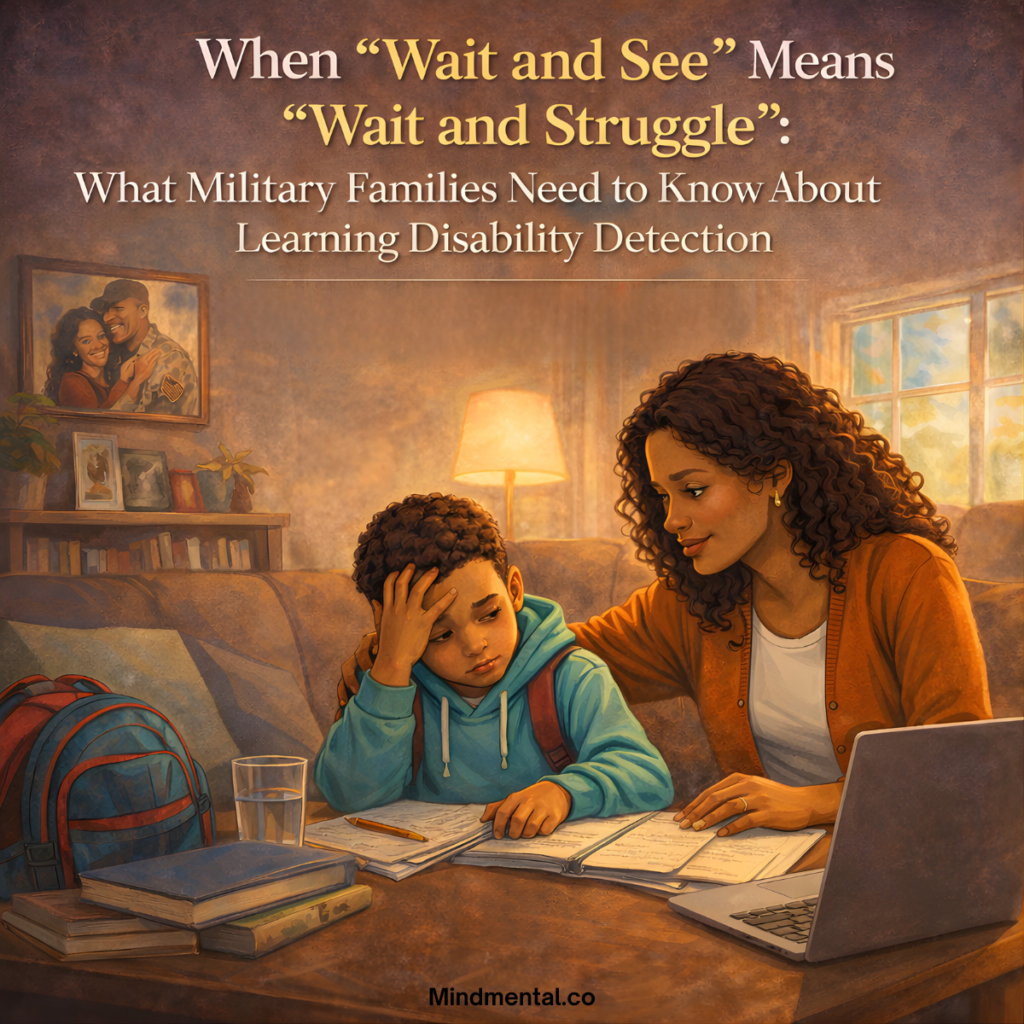
When “Wait and See” Means “Wait and Struggle”: What Military Families Need to Know About Learning Disability Detection
As a military spouse and mother navigating the complexities of special needs in military life, I’ve learned that some of our biggest challenges come not from what TRICARE covers, but from the gaps families must navigate on their own.
The Three Years That Changed Everything
When my son was four, I knew something was different. He was bright — incredibly bright — but letters seemed to swim on the page for him. He reversed them constantly, grew frustrated trying to write his name, and avoided books despite loving stories when I read aloud.
“He’s just not ready yet,” his pediatrician assured me during his well-child visit. “Boys especially develop reading skills later. Let’s wait and see.”
So I waited.
Kindergarten came, and those same signs persisted. When I shared my concerns during our first parent-teacher conference, I heard a similar response: “We don’t see it as a problem yet. He’s smart and engaged. Let’s give him time to adjust to the school environment.”
So I waited again.
It wasn’t until the final month of kindergarten that his teacher finally said the words I both feared and hoped to hear: “We think he might have dyslexia. We should begin the referral process for testing.”
Testing happened the following fall. The IEP meeting came before the holidays, but with winter break and implementation delays, meaningful support didn’t begin until the second semester of first grade.
By the second week of second grade, my son was in crisis. Two and a half years of struggling — of being told he just needed more time — had taken a toll. Homework triggered meltdowns. He began calling himself “stupid.” Morning stomachaches became routine.
That’s when I realized something important: delays are rarely about a single professional’s dismissal — they often reflect a system where early identification pathways are unclear, resources vary widely, and families are left interpreting reassurance when what they need is guidance.
The Resource Gap No One Talks About
The challenge isn’t only insurance coverage – it’s transparency and navigation.
Many military families are surprised to learn that TRICARE often does not cover educational evaluations for learning disorders like dyslexia when they are considered school-based services rather than medically necessary assessments. This leaves families dependent on school systems or private resources to pursue identification.
The difficulty arises when families aren’t clearly told what their options are.
What I needed wasn’t false reassurance. I needed honest information and direction.
I needed someone to say:
“You’re right to be concerned. Here are the resources available. Here’s how to request an evaluation. Here’s what to document.”
Instead, I heard versions of “He’s probably fine,” while watching my child’s confidence slowly erode.
For military families, the impact is amplified:
- Frequent moves require portable strategies, not provider-dependent solutions
- Limited local support networks make navigation harder
- Military stressors can complicate learning challenges
- Each relocation often means restarting advocacy from the beginning
What families need most is a bridge — professionals who validate concerns even when solutions fall outside their immediate scope.
The Unintended Consequences of “Wait and See”
Looking back, I don’t believe professionals intended harm. More often, “wait and see” reflects uncertainty, developmental variability, or limited referral pathways rather than dismissal.
But the outcome for families can still be the same: lost time.
Pediatricians typically do not conduct formal learning disability evaluations, but they can identify risk factors and guide families toward assessment. Schools often rely on intervention frameworks that require documented struggle over time before formal evaluation begins. Both systems have reasons for their processes — yet families experiencing early warning signs may feel stuck between them.
Everyone hopes a child will catch up naturally. Sometimes they do.
But sometimes they don’t — and early action matters.
Research consistently shows that early elementary years are when reading intervention is most effective. Delays don’t just affect academics; they affect identity, confidence, and emotional well-being.
Transparency matters.
Parents know their children. When concerns are raised, professionals who validate those concerns while providing clear next steps — even if those steps fall outside their direct scope — become invaluable partners in early intervention.
What Military Parents Can Do
If you’re concerned about your child’s learning development, here are concrete steps you can take:
Document Everything
Keep a detailed record of:
- Specific behaviors and patterns you observe
- When concerns first appeared
- Examples from homework, classwork, or daily activities
- Your child’s emotional responses to learning tasks
- Conversations with teachers and pediatricians
This documentation becomes crucial evidence when requesting formal evaluation.
Request Formal Evaluation
You have the right to request a formal evaluation at any time by submitting a written request to your child’s school. Schools must respond within specific timeframes (typically 30 days for initial response, though timelines vary by state).
Your request doesn’t need to be lengthy. A simple email or letter stating:
“I am requesting a formal evaluation for my child, [Name], to determine if they are eligible for special education services. I have concerns about [specific areas: reading, writing, math, etc.].”
Know Your TRICARE Limitations
TRICARE often does not cover educational evaluations for learning disorders when considered school-based rather than medically necessary. However:
- Ask your pediatrician about referrals for developmental assessments that may be covered
- Some neuropsychological evaluations may be covered if framed as medical necessity
- Document any medical concerns (anxiety, behavioral issues) that may support coverage
Seek Second Opinions
If reassured but still concerned, it’s okay to:
- Consult with another provider
- Request a developmental pediatrician
- Request neuropsychological evaluation
- Pursue private assessment if financially feasible
- Contact your installation’s Exceptional Family Member Program (EFMP) for guidance
Prepare for PCS Moves
- Request copies of all evaluations and records before moving
- Have a system in place to hold documentaion related to IEP/504 accommodations in writing
- Research special education resources at your new duty station/join social media groups in the area
- Connect with EFMP at your new installation before arrival
- Understand that IEPs transfer, but implementation may vary
Resources for Military Families
Exceptional Family Member Program (EFMP)
Your installation’s EFMP can help navigate:
- Educational advocacy
- Resource coordination
- Assignment consideration for special needs
- Transition support during PCS moves
Find your local EFMP through your installation’s Military and Family Support Center.
Military OneSource
Call: 800-342-9647 or visit militaryonesource.mil
Free consultation services including:
- Educational advocacy support (up to 12 sessions per issue)
- Special needs resource navigation
- Military life transition assistance
- Legal consultation for education rights
Department of Defense School Liasion Program
Visit dodea.edu
Early Intervention Matters
Research consistently shows that early elementary years are when reading intervention is most effective. Waiting doesn’t just affect academics – it affects identity, confidence, and emotional well-being.
If professionals tell you to “wait and see,” you can also choose to “advocate and act.”
Trust your instincts. Document your observations. Request evaluations. Seek support.
Your child’s learning journey doesn’t have to include years of unnecessary struggle.
The bridge between concern and support exists – sometimes you just have to build it yourself.
Explore capacity-based planning workbooks designed for military families at mindmental.co
Let’s Connect
Have you navigated “wait and see” advice for your child? What helped you move forward? Share your experience in the comments.
If you’re a military family member or neurodivergent parent navigating the gap between what your child needs and what is being provided, we see you.
Email: hello@mindmental.co
Newsletter: Sign up to receive monthly articles and resources.
Blog: New posts weekly
ABOUT MINDMENTAL
We provide trauma-informed resources and tools for military families – active duty, separated, retired, and veteran – navigating the unique pressures of military life and post-service transition, especially those with neurodivergent children. Because capacity should always come before expectation
Important Note: I am not a licensed therapist or counselor and I do not provide clinical mental health services. Mindmental offers educational resources, organizational tools, and community support based on professional experience and lived expertise. For clinical care, please contact a licensed provider.
© 2026 Mindmental. All rights reserved.
This article is based on personal experience and general information. It is not a substitute for professional medical, educational, or legal advice. Always consult qualified professionals for your specific situation.