School & IEP Support

Book cover showing a military family during a PCS move. A mother holds a box labeled "fragile," children sit on moving boxes looking tired, suitcases are packed, and a service member in uniform walks toward a moving truck. Title reads "The Hidden Load: What Military Families Carry When Everything Changes" with a rainbow infinity symbol logo.

The Hidden Load: What Military Families Carry during PCS

There’s a moment that almost every military family knows. The orders come in. The timeline collapses. And before you’ve had a single quiet moment to process what’s happening, the lists begin. Schools to research. Utilities to transfer. A house to pack. A child to prepare. A community to leave behind – again. And somewhere in […]

The Hidden Load: What Military Families Carry during PCS Read More »

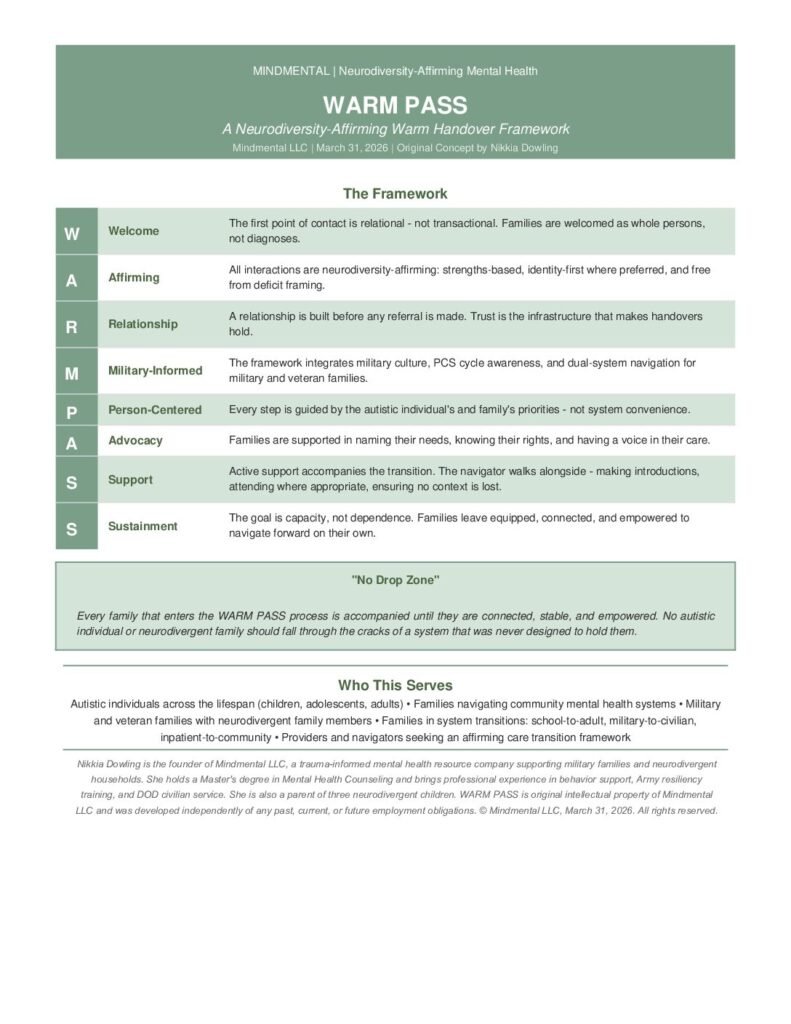
When the System Drops You: Introducing the WARM PASS Framework

There is a moment that too many families know. You finally found the right therapist. Or the right school program. Or the right specialist who actually understood your child. And then something changed – a move, a graduation, a discharge, an insurance switch, a provider leaving – and suddenly you are back at the beginning.

When the System Drops You: Introducing the WARM PASS Framework Read More »

Watercolor illustration of a military mother comforting a child amid moving boxes during a PCS move. A second child sits alone in the background with head in hands. A moving truck, school building, and IEP folder are visible. Rainbow infinity symbol and Mindmental logo displayed. Text reads: When the Mission Moves But Your Child Doesn't: Transition Through a Neurodivergent Lens.

When the Mission Moves But Your Child Doesn’t: Transition Through A Neurodivergent Lens

My children don’t transition the way the checklist assumes they will. None of my three do. And if you’re reading this, there’s a good chance yours don’t either. The standard military transition timeline: Pack, move, in-process, enroll in school, settle in. This was designed around a version of family that doesn’t account for the child

When the Mission Moves But Your Child Doesn’t: Transition Through A Neurodivergent Lens Read More »

A group of educators sits around a table reviewing documents, with a clipboard showing a checklist in the foreground. Text reads “Know Your IEP Rights Before You Sit Down.”

5 Things Every Parent Should Know About IEP Meetings

5 Things Every Parent Should Know About IEP Meetings If you’re a parent navigating the IEP process, you know the meetings can feel intimidating. There’s a table full of professionals: teachers, administrators, specialists, and you’re trying to advocate for your child while also understanding a system that seems designed to confuse rather than clarify. I’ve

5 Things Every Parent Should Know About IEP Meetings Read More »

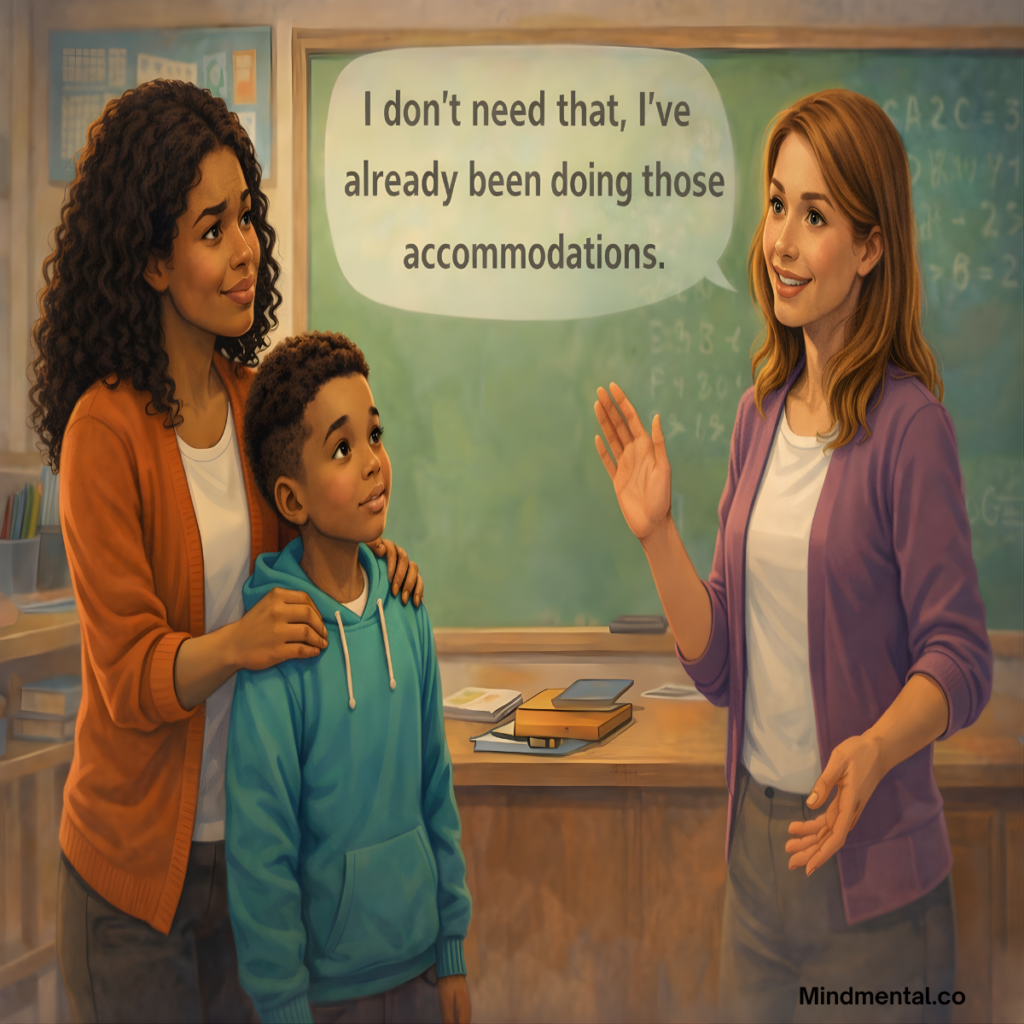
Illustration of a parent and child meeting with a teacher in a classroom. The teacher is gesturing dismissively while saying "I don't need that, I've already been doing those accommodations." The parent appears frustrated, standing protectively near their child. The scene depicts a common IEP or 504 meeting dynamic where parents face resistance when requesting formal support.

The “I’m Already Doing That” Problem: IEP Accommodations

When Teachers Say “I’m Already Doing That”: What It Really Means and What to Do About It You’re sitting in an IEP meeting. You’ve come prepared – binder organized, data printed, accommodations researched. You ask for something your child needs. Extended time on tests. Preferential seating. Visual schedules. Breaking assignments into chunks. And the teacher

The “I’m Already Doing That” Problem: IEP Accommodations Read More »

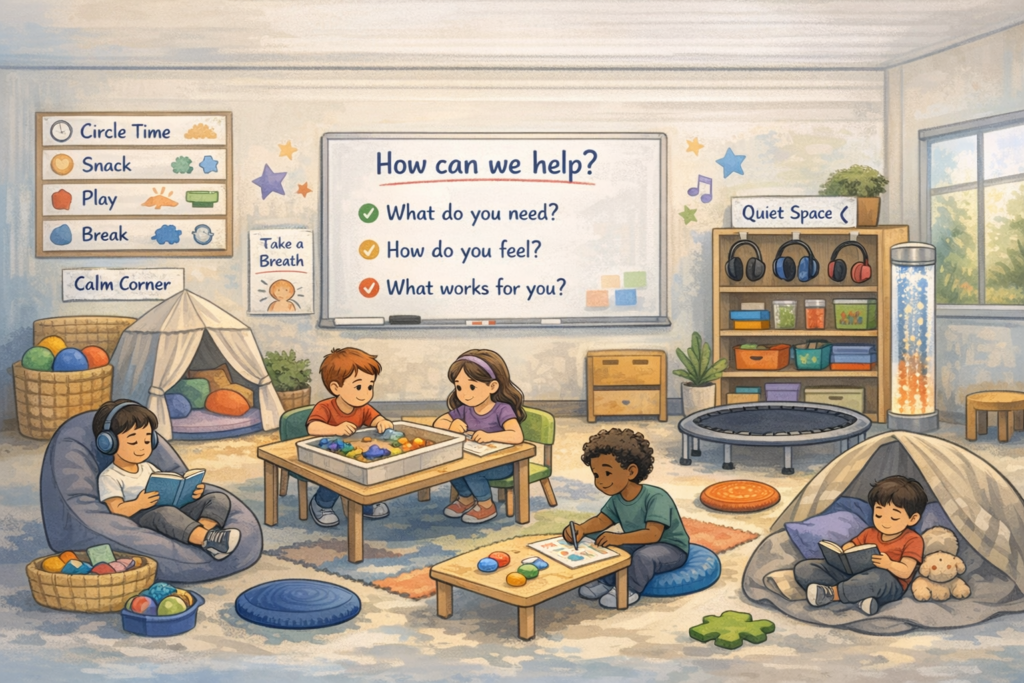
An inclusive elementary classroom with sensory tools, flexible seating, and a central whiteboard asking “How can we help?” Children engage in reading, drawing, and sensory play in a calm, neurodiversity-affirming environment.

Support Without Labels: A Needs-Based Approach for Programs

Support Without Labels: A Needs-Based Approach for Programs Serving Diverse Learners Military families are asked to explain their children over and over again – at every new duty station, every new school, every new provider. And too often, the first question they face is a label‑based one:“Does your child have special needs?”For many families, that

Support Without Labels: A Needs-Based Approach for Programs Read More »

Mother comforting frustrated child struggling with homework at table, military family photo on wall, warm evening lighting illustrating learning disability challenges

When “Wait and See” Means “Wait and Struggle”: What Military Families Need to Know About Learning Disability Detection

When “Wait and See” Means “Wait and Struggle”: What Military Families Need to Know About Learning Disability Detection As a military spouse and mother navigating the complexities of special needs in military life, I’ve learned that some of our biggest challenges come not from what TRICARE covers, but from the gaps families must navigate on

When “Wait and See” Means “Wait and Struggle”: What Military Families Need to Know About Learning Disability Detection Read More »

A young boy in a teal hoodie and backpack tells his mother, “I went for dyslexia.” They stand in a warm, cozy room with bookshelves and a window. The mother smiles gently, listening with care. Title text reads: “He Said Dyslexia: When Our Kids Name What We Haven’t Explained Yet.”

“He Said Dyslexia”: When Our Kids Name What We Haven’t Explained Yet

“He Said Dyslexia”: When Our Kids Name What We Haven’t Explained Yet My son usually tells me he went to “the office for reading.” It’s a phrase we’ve both come to accept – gentle, neutral, supportive. But one day, he said something different. “I went for dyslexia.” He said it like it was just another

“He Said Dyslexia”: When Our Kids Name What We Haven’t Explained Yet Read More »