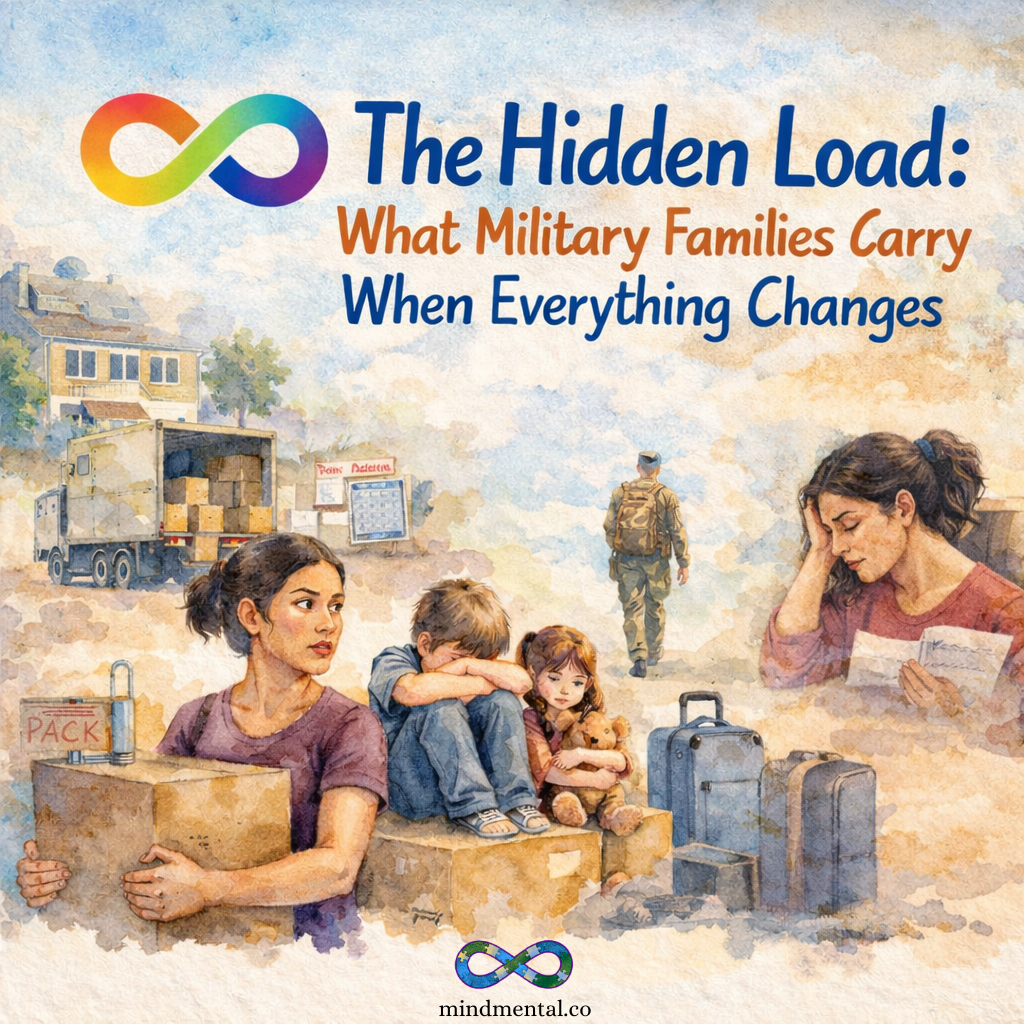
There’s a moment that almost every military family knows.
The orders come in. The timeline collapses. And before you’ve had a single quiet moment to process what’s happening, the lists begin. Schools to research. Utilities to transfer. A house to pack. A child to prepare. A community to leave behind – again.
And somewhere in the middle of all of it, someone asks how you’re doing, and you say fine because what else would you say? There is no time to not be fine. The mission moves forward, and so do you.
But here’s what nobody talks about enough: the weight of that moment doesn’t disappear just because you keep moving. It accumulates. It settles into your body, your sleep, your patience, your ability to show up for your kids when they need you most. It becomes what I call the hidden load -the invisible labor of holding a family together through repeated upheaval, while managing your own grief about what’s being left behind.
This article is for the parent carrying that load right now. And it’s especially for the parent who is carrying it while also trying to support a child who experiences the world a little differently than most.
Transition Is Not Just Logistics
We tend to talk about military transitions in logistical terms. PCS checklists. School enrollment packets. In-processing appointments. And yes, those things matter -they have to get done.
But transition is not just a logistics event. It is a full-system disruption for your family. Routines that took months to build disappear overnight. Friendships that took years to develop are suddenly long-distance. The pediatrician who finally understood your child’s needs is no longer accessible. The school that had the right support in place is replaced by a new building full of strangers who don’t know your child yet – and may not for a long time.
For most children, this is hard. For neurodivergent children, it can be destabilizing in ways that take months to fully surface.
And for parents – particularly the spouse or caregiver who manages the bulk of the transition logistics – the emotional weight is enormous. You are simultaneously grieving your own losses, managing your children’s, and trying to keep the household functional through one of the most stressful periods a family can face. That is not a small thing. That is an extraordinary amount to carry.
The Capacity Crash Nobody Warned You About
Here is something I want you to understand deeply: capacity is not a character trait. It is a resource. And like any resource, it can be depleted.
When you are in the thick of a military transition – managing the move, navigating a new installation, figuring out schools, rebuilding a support network from scratch -your capacity is being drawn down from every direction simultaneously. There is no pause button. There is no recovery period built into the timeline. You are expected to keep performing at full capacity while running on empty.
And then your child has a meltdown at the dinner table, or shuts down at the new school, or starts waking up at 3 AM every night -and you have nothing left to give. Not because you don’t love them. Not because you’re failing. But because you are a human being with finite reserves, and those reserves have been exhausted.
The capacity crash is real. It is predictable. And it is not a sign that something is wrong with you -it is a sign that the demands placed on military families during transition far exceed what most support systems account for.
The Gaps Families Fall Through
Military families have access to an array of support programs and resources. And many of those programs do genuine good. But there are gaps -quiet, consistent gaps -that show up again and again for families navigating transition.
The gaps tend to cluster around a few areas:
School transition continuity. Moving mid-year, or even between years, means your child’s educational records have to travel with them -and those records don’t always arrive intact, on time, or understood. A child with an IEP or 504 plan enters a new school where nobody knows their history, their triggers, their accommodations, or their strengths. Building that understanding again takes time that families don’t always have.
Community anchors. The therapist. The occupational therapist. The swim instructor who finally figured out how to connect with your child. The other military family down the street who just got it. These relationships are not incidental to your child’s wellbeing -they are load-bearing. When they disappear all at once, the impact is cumulative and significant.
Parental support. Transition support for military families tends to focus on the service member’s career continuity, and to some extent on children’s school transitions. The caregiver managing the household -often a spouse navigating their own career disruption, social isolation, and emotional labor -receives far less structured support. And yet that caregiver is the person whose capacity determines how well the rest of the family weathers the transition.
The emotional processing timeline. Transitions have deadlines. Emotions do not. Families are often expected to be “settled in” and functional long before the emotional work of a major move has been processed. Children, in particular, may not show the full impact of a transition for weeks or months after the physical move is complete.
What You Can Do Right Now
If you are in the middle of a transition, or anticipating one, here are a few things worth holding onto:
Name the load before it names you. Acknowledge -out loud, to yourself and to a trusted person -that what you are carrying is heavy. You do not have to minimize it to keep moving forward.
Protect at least one anchor. If you can maintain one consistent relationship, routine, or resource through the transition -a virtual therapy session, a weekly call with a close friend, a predictable morning rhythm -that anchor matters more than it might seem.
Give your child extra transition time. Even if they seem fine on the surface, assume they need more time than the calendar suggests. Watch for behavioral changes that emerge weeks after the move, not just in the immediate aftermath.
Lower the expectation floor temporarily. This is not the season for maximum productivity, perfect routines, or hitting every goal. This is the season for getting through. Capacity before expectation – always, but especially now.
Ask for help before you hit empty. Military culture tends to reward self-sufficiency. But reaching for support before you’re in crisis is not weakness – it’s strategy.
You Are Not Failing. The Load Is Just Heavy.
Military families are some of the most resilient people I have ever encountered. But resilience is not the absence of struggle. It is the ability to keep showing up in the middle of it – and that requires capacity, not just willpower.
If you are carrying the hidden load right now, I want you to know: you are seen. The weight is real. And you deserve support that actually meets you where you are -not where the checklist says you should be.
Mindmental exists for exactly this moment. If you’re looking for resources, tools, or a community that understands the intersection of military family life and neurodivergent support, you’re in the right place.
Explore resources at mindmental.co
Nikkia is the founder of Mindmental LLC, a trauma-informed mental health resource company supporting military families and neurodivergent households. She holds a Master’s degree and brings professional experience in behavior support, Army resiliency training, and DOD civilian service.
Let’s Connect
Email: hello@mindmental.co
Newsletter: Sign up to receive monthly newsletter with highlights and resources
Blog: New posts weekly
Related Posts
- When the Mission Moves But Your Child Doesn’t: Transition Through A Neurodivergent Lens
- 5 Things Every Parent Should Know About IEP Meetings
- When Teachers Say “I’m Already Doing That”: What It Really Means
- Support Without Labels: A Framework for Talking About Accommodations
- When “Wait and See” Means “Wait and Struggle“
TAGS: #IEP #SpecialEducation #ParentAdvocacy #Neurodivergent #MilitaryFamilies #IEPMeetings #ParentRights #EducationAdvocacy #SpecialNeeds #IEPAdvocacy #Parenting