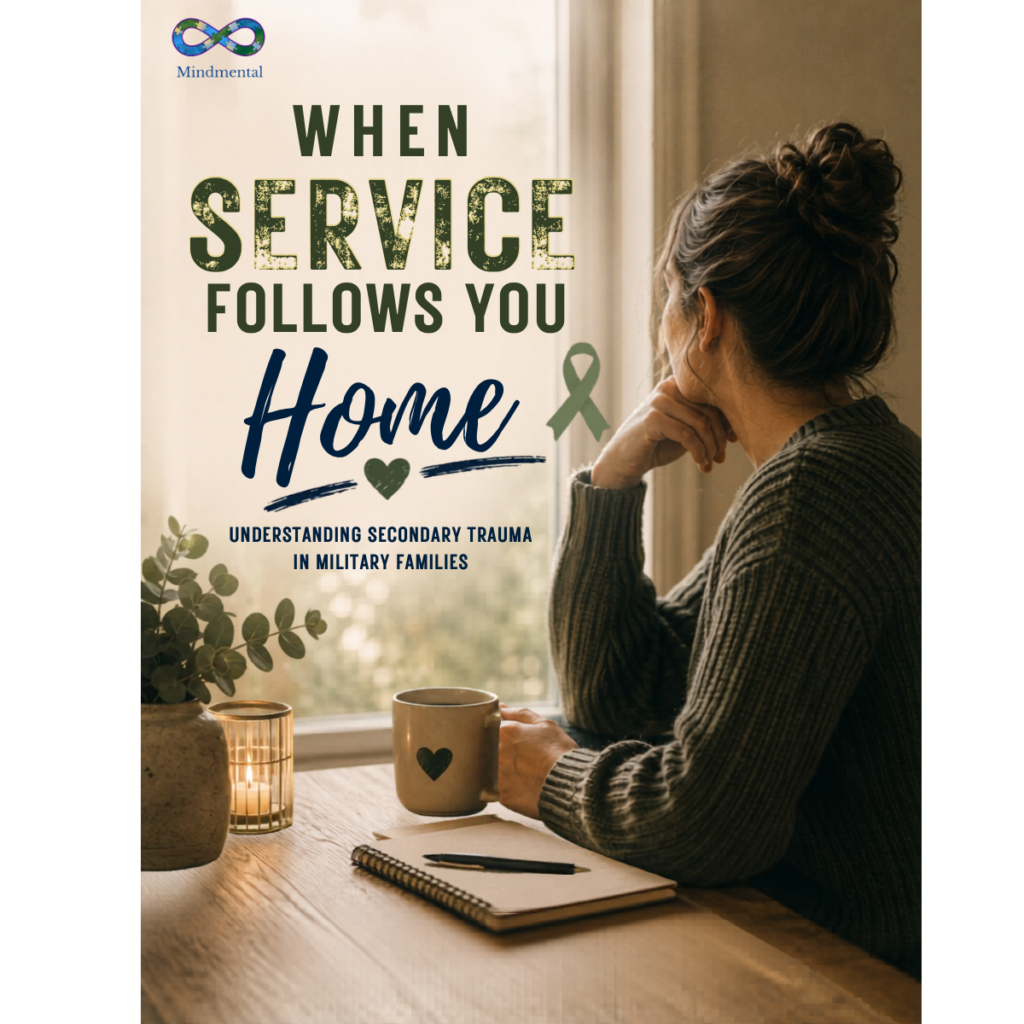
There is a version of this story that gets told often.
The service member comes home changed. The family adjusts. Time passes. Things get better – or they do not. Either way, the story centers the veteran, the diagnosis, the individual who served.
What that story leaves out is everyone else in the house.
The spouse who learned to read the room before walking through the door. The child who stopped asking for things on hard days because they could feel the tension before anyone said a word. The parent who managed their own fear, grief, and exhaustion in the margins of someone else’s recovery, and never once called what they were carrying by its real name.
Secondary traumatic stress is real. It is documented. And in military families, it is deeply, systematically under-addressed.
What Secondary Trauma Actually Is
Secondary traumatic stress, which is sometimes called compassion fatigue or vicarious trauma, happens when someone develops trauma-like symptoms as a result of close exposure to another person’s trauma.
You do not have to have been deployed. You do not have to have witnessed combat. You do not have to have experienced the event directly.
What you do have to have done is love someone who did and carry that alongside them, often without support, often without acknowledgment, and often while managing everything else a household requires.
For military spouses and families, this can look like:
- Hypervigilance — monitoring your partner’s mood before you speak, managing the household to prevent triggers, bracing before they walk in the door
- Emotional exhaustion — feeling depleted in ways that sleep does not fix
- Avoidance — steering clear of topics, situations, or people that create friction at home
- Anxiety that feels outsized — worrying in ways that seem disproportionate, even to you
- Numbness — going through the motions of daily life without feeling present in it
- Guilt — for struggling, for needing things, for not being more patient or more understanding
These are not personality flaws. These are responses to sustained, close-proximity exposure to another person’s trauma, all while simultaneously managing a household, raising children, and often doing it largely alone.
The Military Household Is a Specific Kind of Hard
Military life does not just add stress to a relationship. It restructures the entire emotional architecture of a family.
Deployment means months of solo parenting, compressed grief, and suppressed fear. This can be followed by reintegration, which brings its own adjustment period that is rarely talked about honestly. The service member comes home changed. The family changed too. And the work of figuring out how to be in the same space again is real, quiet, and largely invisible to the outside world. When you add the rhythm of PCS moves every two to three years, starting over in a new community, rebuilding support systems, finding new providers, enrolling kids in new schools — and the cumulative weight becomes something most civilian frameworks have no category for.
Research consistently shows that military children are at increased risk for adverse mental health outcomes compared to their civilian peers. Children of service members carry more. They absorb more. They adapt in ways that look like resilience but can mask significant stress responses underneath.
The spouse, the one managing the logistics, the emotions, the children, the paperwork, the transitions, and the invisible labor of keeping a household functional through all of it, is often the last person anyone asks about.
What It Looks Like in a Real Household
Secondary trauma in a military household rarely announces itself.
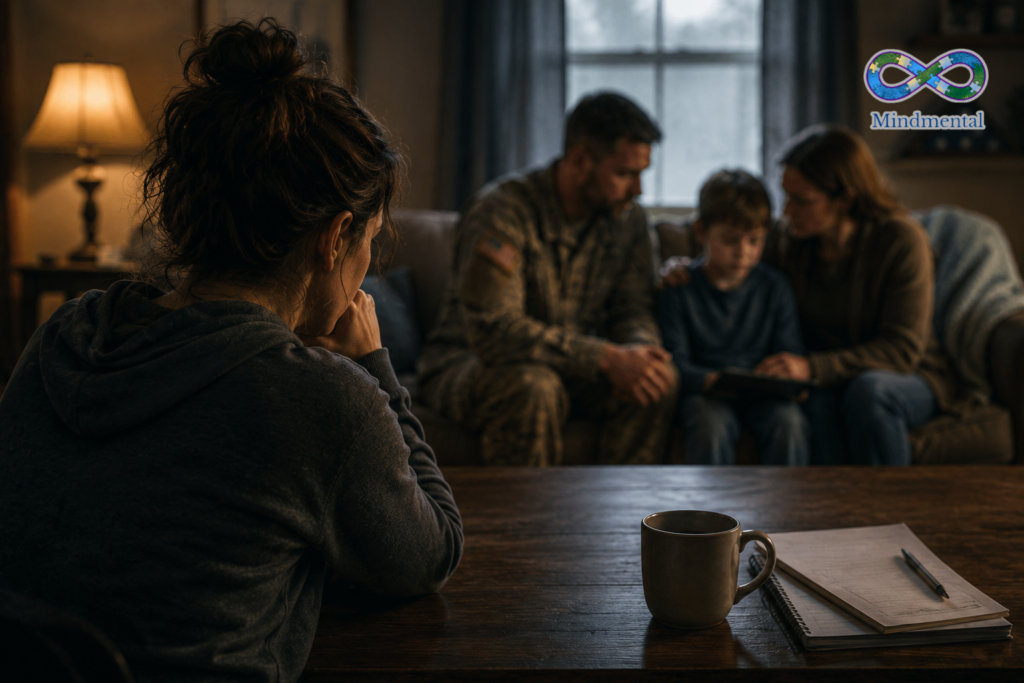
It shows up as the spouse who has learned exactly how to de-escalate a difficult moment without ever being taught how. The parent who checks their own emotional responses at the door because the household cannot hold two people struggling at once. The child who becomes the peacekeeper, the helper, the one who does not add to the pile.
It shows up in the exhaustion that does not lift. The relationships that feel distant even when everyone is in the same room. The sense that something is wrong but you cannot name it because nothing specific happened — it just accumulated.
It shows up in the belief that your experience does not count because you were not the one deployed. Because you were not the one in danger. Because compared to what they went through, what right do you have to struggle?
You have every right.
Trauma does not require proximity to a battlefield. It requires proximity to pain, which is sustained, unaddressed, and unsupported. Military families live in that proximity regularly, and they deserve to have it named.
For Families with Neurodivergent Children, the Weight Compounds
When a household is also navigating a child’s neurodivergent needs therapies, IEPs, behavioral support, sensory regulation, and the relentless advocacy work that specialized parenting requires – secondary trauma does not exist in isolation.
It layers.
The spouse who is managing a service member’s PTSD and a child’s meltdowns and a PCS transition and the loss of a therapy provider they finally found is not dealing with one hard thing. They are dealing with a system of hard things that interact with each other in ways that compound the load at every point.
Research has shown that limited respite care significantly increases stress, anxiety, and depression in military parents of children with special needs. When there is no space to set the weight down, not even briefly, the weight becomes part of how you function. And functioning under that kind of sustained load changes you.
This is not weakness. This is what happens to human nervous systems that are not given adequate support.
Naming It Is Not Complaining
One of the most persistent barriers military spouses face in acknowledging secondary trauma is the culture they are embedded in.
Military culture values strength, adaptability, and resilience. Those are real and meaningful qualities. But they can also become the reason people do not seek help — because seeking help feels like admitting failure, or making it about themselves when someone else has it harder.
You are not competing for who has it hardest.
Your experience is not invalid because someone else’s was more visible. Your needs are not less real because you were not the one deployed. Your nervous system does not require a certain level of suffering before it is allowed to respond.
Naming secondary trauma is not dramatic. It is accurate. And accurate naming is the first step toward getting support that actually fits what you are carrying.
What Support Can Look Like
Finding support as a military spouse navigating secondary trauma is genuinely difficult — especially if you are also managing a child’s specialized needs. The gap between what exists and what is needed is real.
But there are starting points:
- Acknowledge it first, to yourself. You do not need a diagnosis to validate your experience. Simply naming what you are carrying changes your relationship to it.
- Seek trauma-informed care for yourself – not just parenting support or couples counseling, but support that centers your experience as an individual
- Look for providers who understand military life – Military OneSource, TRICARE, and some community-based programs offer services specifically for family members, not just service members
- Connect with peer community – other military spouses who understand the specific weight of this life are often one of the most meaningful sources of support
- Protect your capacity honestly – goals and routines that are built around your actual bandwidth, not an idealized version of what you think you should be able to handle
This Month Is for You
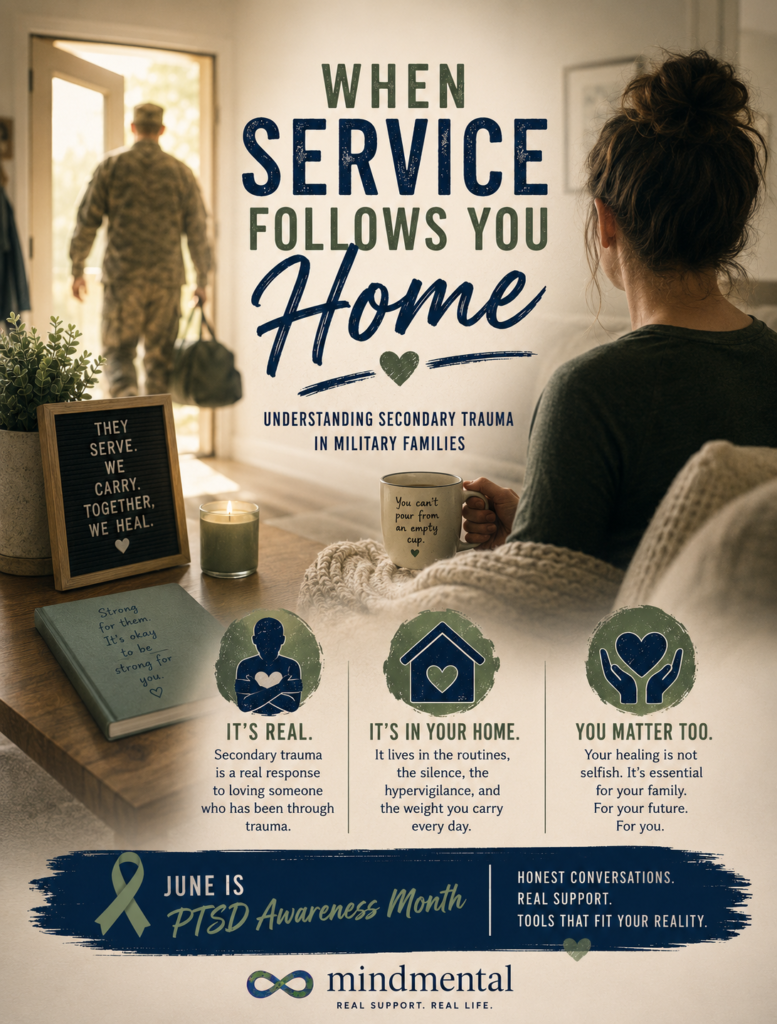
PTSD Awareness Month is not just for veterans. It is for every person whose life has been shaped by proximity to trauma, including the spouses, children, and caregivers who carry it quietly in the margins of someone else’s story.
Throughout June, Mindmental is publishing content specifically for military and neurodivergent families navigating PTSD in all its forms. Next week, we are going deeper into one of the most underreported intersections in this space: PTSD in mothers of autistic children, and how caregiving itself can become a traumatic stressor.
You do not have to have a diagnosis to belong in this conversation. You just have to be living it.
Did you miss the Military Family Mental Health Goals That Actually Matter article?
Read now
Follow me on LinkedIn and Facebook for more resources and real time updates!
Let’s Connect
When we center experience, support becomes inclusive and cultivates belonging.
Email: hello@mindmental.co
Newsletter: Sign up to receive monthly highlights and resources
Blog: New posts weekly
Follow me on LinkedIn and Facebook for more resources and real time updates!
Mindmental creates trauma-informed, capacity-honoring resources for military families, neurodivergent households, and anyone navigating complex seasons of life. Built with lived experience. Backed by professional expertise. Designed for your reality.
This article is for informational and awareness purposes only. It is not intended to diagnose or replace professional mental health support. If you are experiencing significant distress, please reach out to a qualified professional or someone you trust.