Trauma Responses in Military Children: It Doesn’t Require Combat Exposure
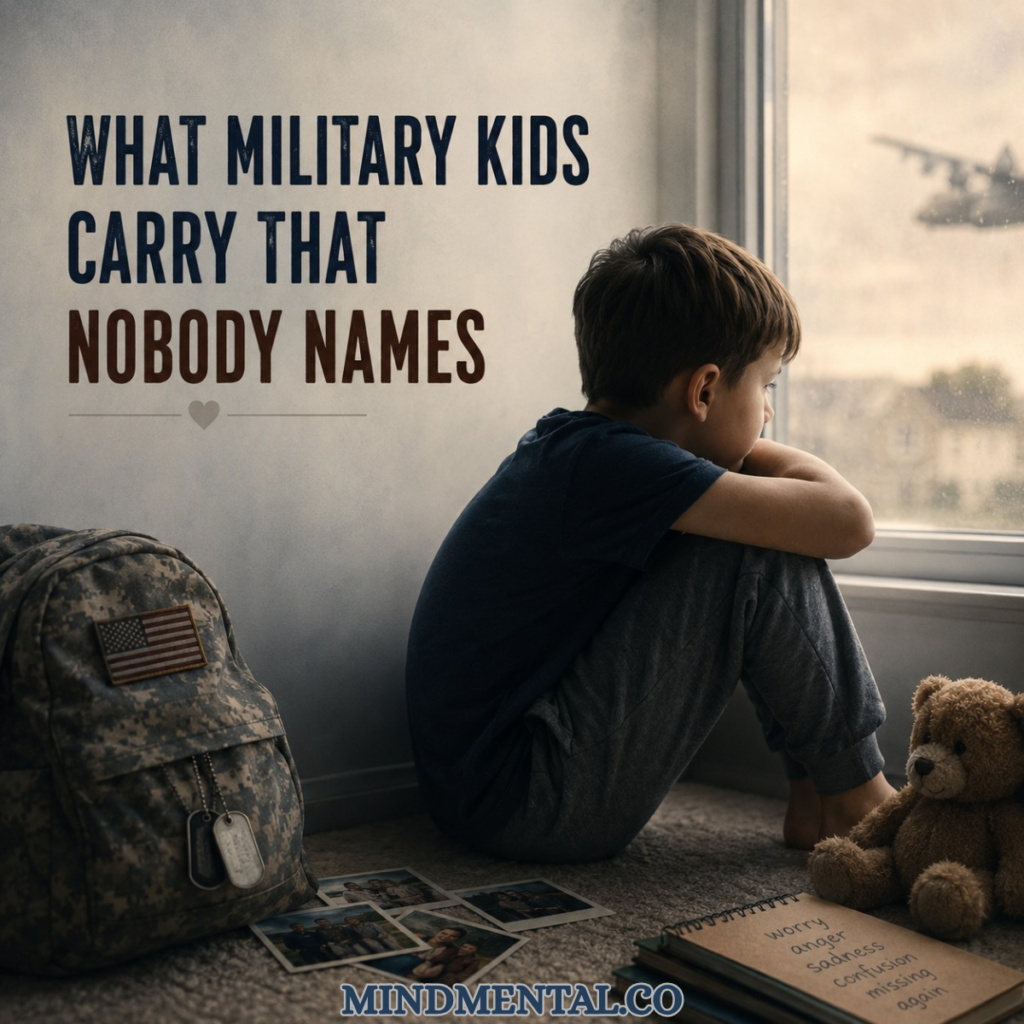
What Military Kids Carry That Nobody Names
Your child was never deployed.
They were never in a combat zone. They were never in danger. By every conventional measure, they were safe – at home, with a parent, living a childhood that looked nothing like war.
And yet something is happening in their nervous system that tells a different story.
The anxiety that spikes when a parent leaves the room. The hypervigilance at school drop-off. The meltdowns that seem disproportionate to the moment. The sleep disruptions. The emotional dysregulation that no one can quite explain. The grief that shows up without a name.
Your child wasn’t there. But they are still carrying something.
And that something has a name.
1. Children Don’t Need to Experience Trauma Directly to Be Affected By It
This is one of the most important – and least talked about – realities in military family mental health.
Trauma does not require direct exposure to a traumatic event. Children are exquisitely sensitive to the emotional environment around them. They absorb the stress, grief, fear, and tension of the adults they depend on – often without any adult realizing it is happening.
Research has consistently shown that children of service members are at increased risk for emotional and behavioral difficulties compared to their civilian peers. Not because they experienced combat. Because they experienced the household that combat shaped.
They felt the shift in the air before a deployment announcement was made. They sensed the tension during reintegration, even when everyone said things were fine. They adapted their behavior to manage a parent’s emotional state before they had language for what they were doing.
Children are not passive bystanders to family stress. They are active participants in the emotional ecosystem of their home – and military family life puts that ecosystem under significant, repeated pressure.
2. What Deployment Actually Does to a Child
Deployment is framed publicly as something service members experience. But children experience it too – just differently.
For a young child, a parent’s absence is not an abstract concept. It is a disruption to the attachment relationship that their entire sense of safety depends on. Even when the remaining parent does everything right – maintains routines, explains the absence clearly, keeps communication going – the child’s nervous system registers the loss.
And then the parent comes back.
Reintegration – the period after a service member returns home – is rarely the joyful reunion that military homecoming videos suggest. It is a period of adjustment, renegotiation, and nervous system recalibration for every member of the household. Children who built new routines, new roles, and new ways of relating during deployment now have to adapt again.
For many children, this cycle – departure, absence, return, adjustment – repeats multiple times throughout their childhood. Each cycle asks their nervous system to do the same hard work of adapting, losing, and rebuilding. Over time, that work accumulates.
3. PCS Moves Are a Form of Repeated Loss
Every two to three years, military families move.
For adults, this is disruptive. For children, it can be genuinely destabilizing.
Every PCS move means:
- Leaving friends they finally felt safe with
- Starting over socially in a new school where no one knows them
- Losing teachers, coaches, and trusted adults who understood them
- Rebuilding a sense of belonging in an unfamiliar environment
- Doing all of this while their parents are also managing the stress of transition
For neurotypical children, this is hard. For neurodivergent children – who often take longer to build trust, struggle with transitions, and depend heavily on predictable environments and relationships – it can be genuinely traumatic.
The grief of losing a friend group at age eight is real grief. The anxiety of walking into a new school where no one knows your name is real anxiety. When children are asked to do this repeatedly, without adequate support or acknowledgment that what they are experiencing is loss, the grief goes underground.
It doesn’t disappear. It accumulates.
4. The Household Stress Children Absorb Without Anyone Noticing
Children are not told everything. But they feel everything.
The conversation that stopped when they walked into the room. The parent who was present in body but somewhere else entirely. The tension that lived in the house during pre-deployment weeks. The way things were different after a parent came home – quieter, more careful, more watchful.
Children are remarkably skilled at reading the emotional environment around them. What they are less skilled at is making sense of what they are reading – or expressing it in ways that adults recognize as stress responses.
Instead, it shows up as:
Behavioral changes: Increased clinginess, withdrawal, defiance, or regression to younger behaviors
Physical complaints: Stomachaches, headaches, and sleep problems without clear medical cause
School struggles: Difficulty concentrating, declining grades, or social withdrawal
Emotional dysregulation: Outbursts, tearfulness, or emotional numbness that seem out of proportion to what is happening in the moment
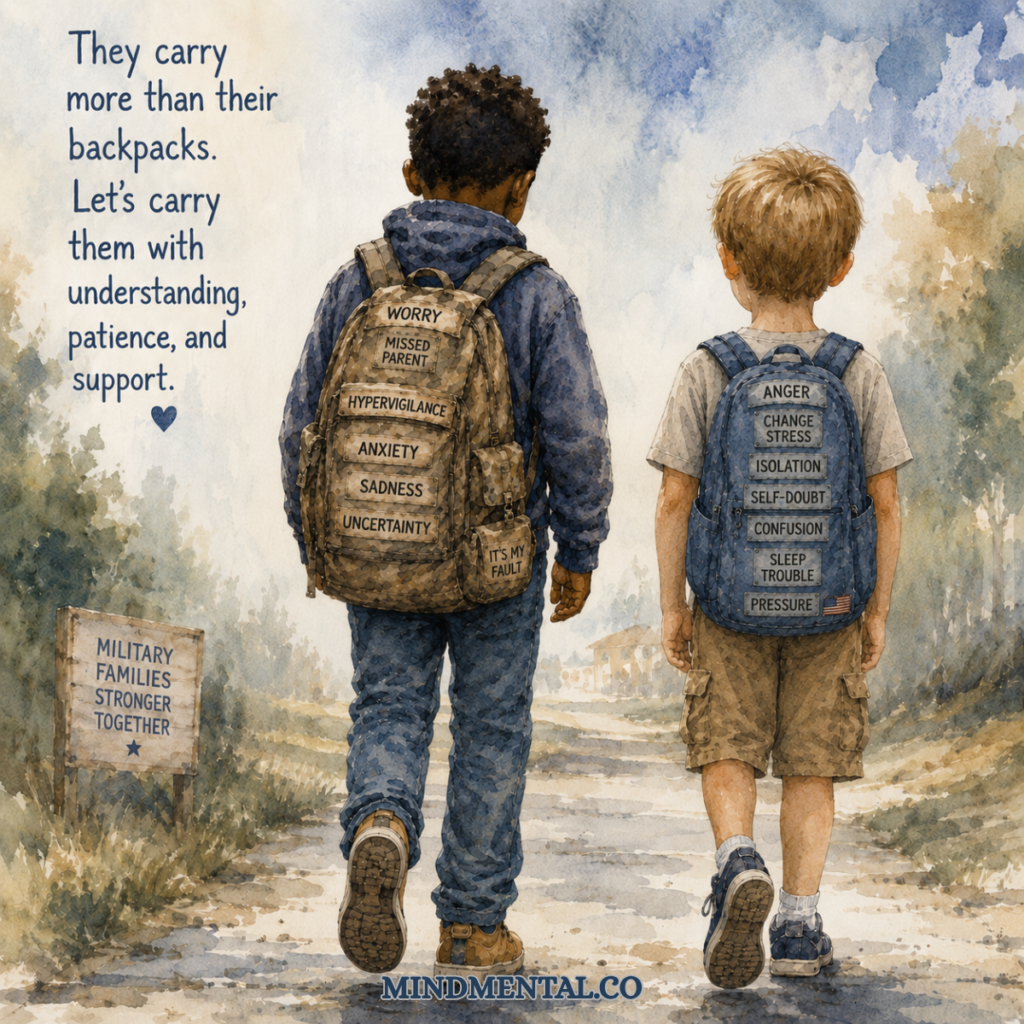
Anxiety responses: Fear of separation, hypervigilance about parent whereabouts, difficulty tolerating uncertainty
None of these are “acting out.” All of them are communication. Your child’s nervous system is telling you what their words cannot yet say.
5. When Neurodivergence Is Also Part of the Picture
For neurodivergent military children, the impact compounds in ways that are frequently misunderstood.
Autistic children, children with ADHD, and children with sensory processing differences already navigate a world that requires significant adaptation from them every single day. Add deployment cycles, PCS moves, and household stress – and you are asking a nervous system that is already working harder than most to carry additional weight.
The challenge is that trauma responses and neurodivergent presentations can look nearly identical from the outside.
Hypervigilance looks like anxiety. Emotional dysregulation looks like behavioral problems. Withdrawal looks like social difficulty. Sensory overload in a new environment looks like a meltdown.
When providers and educators see a neurodivergent child struggling, they often attribute everything to the diagnosis. The military family context – the deployment history, the number of schools attended, the repeated losses – is rarely part of the clinical picture.
Your child may be carrying both. And both deserve to be seen.
6. What This Is Not
This is not about blame.
Military service is not something families chose carelessly. The sacrifices made are real, the pride is real, and the love that holds these families together through impossibly hard seasons is real.
This is not an argument that service members should not deploy, or that military life is inherently harmful to children.
This is an argument that children in military families are carrying something that deserves to be named – not minimized, not explained away, and not left unaddressed because it doesn’t fit the conventional definition of trauma.
Your child is not broken. Their nervous system is responding to a genuinely hard set of circumstances. That response makes sense. And it deserves support.
7. What Children Need When They Are Carrying This
Children who are carrying the invisible weight of military family stress need a few specific things:
To have their experience named. Children who are given language for what they are feeling – “it makes sense that you feel worried when Daddy leaves” – have better outcomes than children whose feelings go unacknowledged.
Consistency and predictability where possible. When the external world is unpredictable, internal routines become anchors. Bedtime rituals, predictable mealtimes, and reliable emotional availability from the present parent provide nervous system regulation when the larger environment cannot.
Permission to grieve. Children need to know that missing someone, feeling angry about a move, or being sad about losing a friend is allowed. Grief that is not permitted goes underground. Grief that is witnessed and validated moves through.
A trusted adult who sees them. This doesn’t have to be a therapist – though therapeutic support can be genuinely helpful. It can be a teacher, a coach, a family friend, or the non-deployed parent. Children need at least one consistent adult who is paying attention to them specifically – not to the household, not to the transition, but to them.
A parent who is also taking care of themselves. Your nervous system regulation directly affects your child’s ability to regulate. The most powerful thing you can do for your child in a hard season is not to manage their feelings perfectly – it is to manage your own with honesty, support, and self-compassion.
8. Permission Statements for Parents Reading This
If this article is landing somewhere tender, these are for you:
☐ Permission to grieve what military life has cost your child, even while being proud of your family’s service
☐ Permission to name what your child is carrying without feeling like you are criticizing the military
☐ Permission to seek support for your child’s emotional needs without waiting for a crisis
☐ Permission to acknowledge that this has been hard for everyone – including the little people in your house
☐ Permission to advocate for your child in school, in therapy, and in every system that doesn’t automatically account for military family experience
☐ Permission to tell your child: “Your feelings make sense. You are not too much. I see you.”
What Comes Next
Next in our June series: “You Can’t Pour From an Empty Cup: PTSD Caregiver Fatigue Is Real” – for the military spouse doing double duty as parent, caregiver, household manager, and emotional anchor. No performance required.
Did you miss the When Service Follows You Home: Understanding Secondary Trauma in Military Families
article?
Have something to add? Leave a comment below. This community grows when we share what we know from the inside.
Mindmental creates trauma-informed, capacity-honoring resources for military families, neurodivergent households, and anyone navigating complex seasons of life. Built with lived experience. Backed by professional expertise. Designed for your reality.
This article is for informational and awareness purposes only. It is not intended to diagnose or replace professional mental health support. If you or your child are experiencing significant distress, please reach out to a qualified professional or someone you trust.
Let’s Connect
Email: hello@mindmental.co
Newsletter: Sign up to receive monthly highlights and resources
Blog: New posts weekly