When I returned to an office role this spring, we reached out to the daycare our youngest had attended for a full year before the pandemic disruptions, before essential academics became our rhythm.
We hadn’t re-enrolled back then because he was aging out of the pull-up-friendly classrooms and wasn’t yet fully potty trained. But now, more than a year into successful potty training – and with his sibling already attending – it felt like the right time to try again.
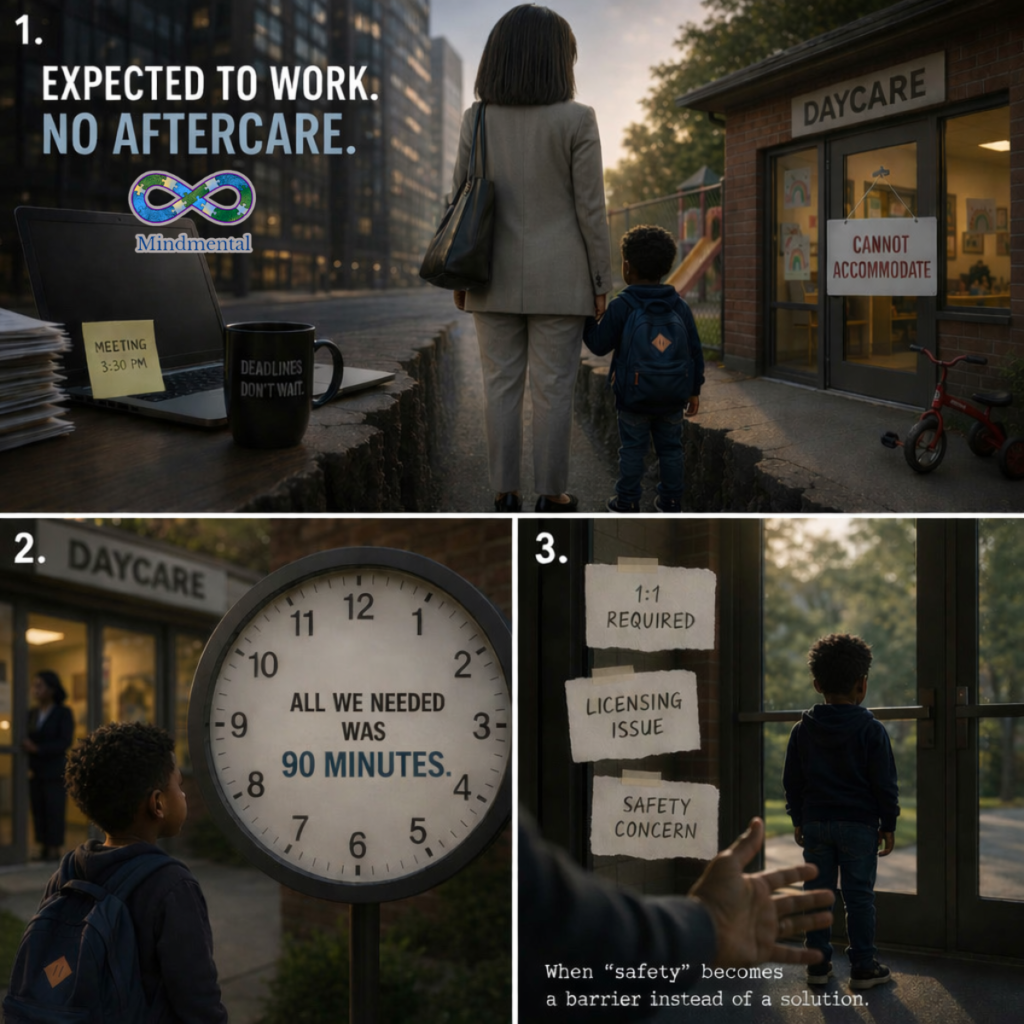
We weren’t asking for full-time care. Just after-school care for six weeks. A simple 1.5-hour window from 3:45 to 5:00, to ease into a routine and see if summer enrollment made sense.
Tuesday to Friday: How Quickly “Welcome Back” Became “We Can’t”
He attended on Tuesday. By Friday, we were pulled aside.
They told us they “couldn’t accommodate him.” That he “needed 1:1.” That they had “safety concerns” because he walked toward the exit door.
This is a child who rides the van from school without issue. A child who transitions into the building at 3:45 and is picked up by 5:15. A child they already knew – who had been in their care for a full year of his life.
Still, they said they could only keep him for the remainder of the week and no longer.
When the Explanation Keeps Changing
When I followed up a few days later to clarify – to ask whether they truly couldn’t support him for just 90 minutes a day until the end of the school year – just one month – the explanation shifted again. This time, it was a “licensing issue.”
Licensing, but only after one week.
Licensing, but only for one child.
Licensing, but only once they realized he might need more supervision than the average child.
What made the exclusion more difficult to understand was seeing that the center could and did provide extra support in other situations when they chose to. It became clear that the issue wasn’t an absolute lack of capacity, but a lack of willingness to extend that same flexibility to our family.
The capacity existed. The willingness didn’t.
When the reasoning changes every time you ask, it becomes clear: the real issue isn’t licensing. It’s willingness.
This Is Where the Story Becomes Bigger Than One Family
The reality is that families are asked to meet work expectations inside systems that offer almost no flexibility for children with support needs.
When programs can’t or won’t adapt, parents are left carrying the full weight of that gap – not because of a lack of effort, but because the structure around them was never built with their children in mind.
Parents are expected to work.
Parents are expected to “figure it out.”
But many families don’t have relatives nearby. Many don’t have a community safety net. And the common advice to “just ask a neighbor” ignores the reality that not every child can be safely handed off to someone unfamiliar with their needs – and not every parent has neighbors who can take on that responsibility.
Safety Concerns Are Real. So Is the Lack of Support.
I don’t dismiss safety concerns. I take them seriously.
But when programs cite safety without offering solutions, the burden shifts entirely onto parents who are already stretched thin.
What would accommodation have looked like?
- A staff member redirecting him when he approached the door
- A visual schedule to help him understand the routine
- A conversation about what specific support he needed
- Training for staff on neurodivergent behavior patterns
- Communication with his school about strategies that work
Instead, we got “we can’t accommodate him” after three days.
Not “we need more information.”
Not “let’s problem-solve together.”
Just “we can’t.”
This Wasn’t About Convenience
This was about creating a small, predictable window of care that would allow our family to meet basic work obligations – something every parent should be able to access without fear of exclusion.
90 minutes.
Six weeks.
A child they already knew.
And it was still too much to ask.
What Happens Next?
I don’t have an answer yet.
We’re back to figuring it out – rearranging work schedules, searching for emergency care for situations we are predicting are bound to occur.
And we’re one of the lucky families. We have some flexibility, but no family nearby who can help occasionally. We are uncertain of what next school year will bring as we attempt to explore other non-existent options.
But what about the families who don’t have ANY flexibility and are forced to rely on a provider’s willingness to try?
What about the single parents?
What about the military families who just PCS’d and don’t have a support network yet?
What about the families who can’t afford to leave work early or lose their job?
What happens to them when their child “can’t be accommodated”?
The System Isn’t Built for Our Kids
Childcare licensing regulations weren’t written with neurodivergent children in mind.
Staff training programs don’t include trauma-informed care or sensory regulation strategies.
Ratio requirements don’t account for children who need more supervision.
And when families advocate for their kids, they’re met with:
“We’re not equipped.”
“We don’t have the resources.”
“It’s a liability issue.”
“We can’t accommodate.”
But exclusion is also a choice.
What Needs to Change
1. Licensing regulations that account for neurodivergent support needs
Staff-to-child ratios should allow for flexibility when children need more supervision – without requiring formal diagnoses or 1:1 aides that families can’t afford.
2. Mandatory training for childcare providers
Understanding autism, ADHD, sensory processing differences, and trauma-informed care should be standard – not optional.
3. Inclusive policies, not just inclusive language
Programs that claim to “welcome all children” should have concrete plans for how they’ll actually support kids with different needs.
4. Employer flexibility
Until childcare systems catch up, employers need to recognize that neurodivergent families face unique barriers – and accommodate accordingly.
5. Community-level support
Respite care, parent cooperatives, and trained caregivers who understand neurodivergent needs should be accessible and affordable.
To Other Parents: You’re Not Alone
If you’ve ever been told your child “can’t be accommodated,” you know this feeling.
The shame. The frustration. The quiet panic of wondering how you’ll make work and parenting fit together when the system wasn’t designed for your family.
You’re not asking for too much.
Your child is not “too difficult.”
And you deserve support – not excuses.
To Childcare Providers: We Need You
I know staffing is hard. I know budgets are tight. I know licensing requirements feel impossible.
But when you say “we can’t accommodate,” you’re not just turning away one child.
You’re telling a parent they can’t work.
You’re telling a sibling they can’t stay in the same program.
You’re telling a family their child doesn’t belong.
And I believe you can do better.
Not every program can serve every child. But “we can’t” shouldn’t be the first response – especially for a child you already knew, for a family already connected to your program, for a request as small as 90 minutes a day.
The Question I Keep Asking
If we can’t find 90 minutes of care for a child who rides the school van independently, who has been successfully potty trained for over a year, who has a sibling already enrolled – what hope is there for families with even greater support needs?
If this is too much to ask, what does that say about the childcare system we’ve built?
And how many parents are silently drowning because “we can’t accommodate” is the only answer they ever get?
Final Thought
This isn’t just a childcare problem.
This isn’t just a neurodivergent family problem.
This is a societal problem.
We tell parents to work. We tell them their children deserve inclusion. We tell them services exist.
But when they show up and ask for help, the door closes.
And that needs to change.
Have you experienced childcare exclusion? What would have made a difference for your family? Share your story in the comments – because the more we talk about this, the harder it becomes to ignore.
Let’s Connect
When we center experience, support becomes inclusive and cultivates belonging.
Email: hello@mindmental.co
Newsletter: Sign up to receive monthly highlights and resources
Blog: New posts weekly
Follow me on LinkedIn and Facebook for more resources and real time updates!
Important Note: I am not a licensed therapist or counselor and I do not provide clinical mental health services. Mindmental offers educational resources, organizational tools, and community support based on professional experience and lived expertise. For clinical care, please contact a licensed provider.
© 2026 Mindmental. All rights reserved.