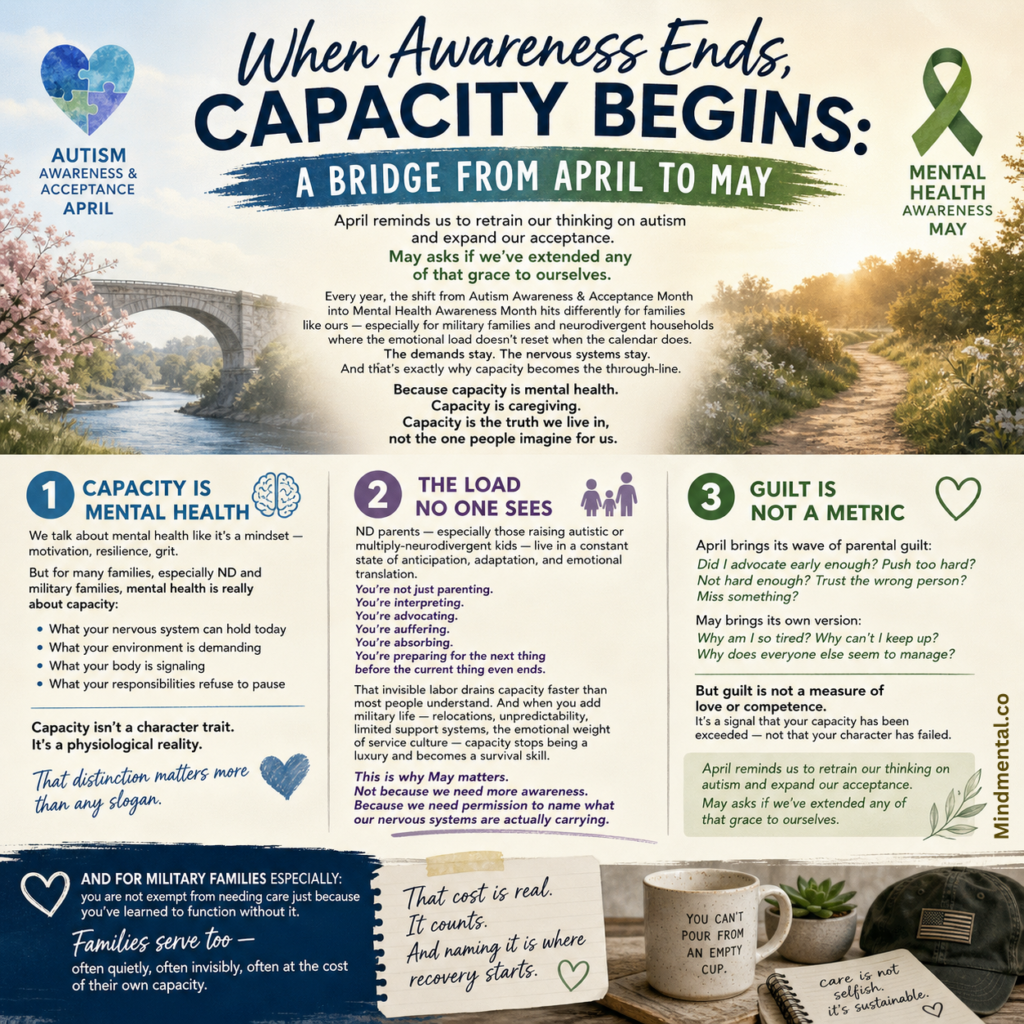
As we move deeper into May and move from Autism Awareness & Acceptance Month and into Mental Health Awareness Month, the transition feels different this year for families like ours. Especially for military families and neurodivergent households where the emotional load never really gets the opportunity to reset.
April asked us to see autistic people more clearly.
May asks us to see ourselves more clearly.
The calendar changed, but the demands didn’t.
And that’s exactly why capacity becomes the through-line.
Because capacity is mental health.
Capacity is caregiving.
Capacity is the truth we live in, not the one people imagine for us.
1. Capacity IS Mental Health
We talk about mental health like it’s a mindset: motivation, resilience, grit.
But for many families, especially neurodivergent and military families, mental health is really about capacity:
- What your nervous system can hold today
- What your environment is demanding
- What your body is signaling
- What your responsibilities refuse to pause
Capacity isn’t a character trait.
It’s a physiological reality.
And during Mental Health Awareness Month, that distinction matters more than any slogan.
When your nervous system is at capacity, “positive thinking” doesn’t create more bandwidth. Rest does. Support does. Reducing demands does.
Mental health isn’t just about what’s happening in your mind, It’s about what your entire system is being asked to carry.
2. The Load No One Sees: Capacity for Neurodivergent Parents
Neurodivergent parents, especially those raising autistic or multiply neurodivergent children live in a constant state of anticipation, adaptation, and emotional translation.
You’re not just parenting.
You’re interpreting.
Your child’s body language, their sensory signals, the cues others miss.
You’re advocating.
At IEP meetings, with doctors, with family members who don’t understand.
You’re buffering.
Between your child and a world that wasn’t designed for them.
You’re absorbing.
Meltdowns, dysregulation, the emotional weight of knowing your child struggles.
You’re preparing.
For the next thing before the current thing even ends.
That invisible labor drains capacity faster than most people understand. And when you add military life, relocations every 2-3 years, deployment cycles, unpredictable schedules, limited support systems, and the emotional weight of service culture, capacity becomes a survival skill, not a luxury.
Awareness campaigns are matter not because we are unaware, but sometimes we need a reminder to give ourselves permission to name what our nervous systems are actually carrying.
3. Guilt Is Not a Metric: The Quiet Battle of Both Months
April often brings a wave of parental guilt:
- “Did I advocate early enough?”
- “Did I push too hard?”
- “Did I not push hard enough?”
- “Did I trust the wrong professional?”
- “Did I miss something?”
May brings its own version:
- “Why am I so tired?”
- “Why can’t I keep up?”
- “Why does everyone else seem to manage?”
- “Why am I not doing more for my own mental health?”
But guilt is not a measure of love or competence.
It’s a signal that your capacity has been exceeded; not that your character has failed.
When you’re running on fumes, guilt whispers that you’re not trying hard enough. But the truth is simpler and harder: you’re carrying more than one person should have to carry.
This is the bridge between April and May:
April asked us to understand our children.
May asks us to understand ourselves.
And Military Appreciation Month reminds us that families serve too.
4. For Military Families Especially: You Are Not Exempt
You are not exempt from needing care just because you’ve learned to function without it.
You are not exempt from burnout just because you’ve survived every PCS, every deployment, every school transition, every lost support system.
Families serve too. Often quietly, often invisibly, often at the cost of their own capacity.
The culture of “mission first” doesn’t mean your wellbeing comes last. It means we need systems that recognize family resilience has limits. Those limits deserve respect, not shame.
When military families are also navigating neurodivergence, the cost multiplies:
- Therapy waitlists at every duty station
- IEPs that don’t transfer cleanly across state lines
- Providers who don’t understand military life or neurodivergent needs
- Childcare that excludes before you’ve even unpacked
That cost is real. It counts. And naming it is where recovery starts.
5. What Capacity-Based Support Actually Looks Like
Capacity-based support doesn’t ask, “Why aren’t you doing more?”
It asks:
✅ “What are you actually carrying right now?”
✅ “What can be reduced, delayed, or removed?”
✅ “What would restoration look like for you?”
✅ “What permissions do you need to give yourself?”
It recognizes that:
- Some seasons are for survival, not growth
- Rest is not laziness, it’s nervous system regulation
- Asking for help is not weakness, it’s wisdom
- Your capacity fluctuates, and that’s normal
Capacity-based support meets you where you are—not where you think you should be.
6. Permission Statements for Moving Through May
As we continue through Mental Health Awareness Month, here are the permissions you might need:
☐ Permission to be tired without feeling like you’re failing
☐ Permission to need support even when you’re “managing”
☐ Permission to lower your standards when capacity is low
☐ Permission to rest without earning it first
☐ Permission to say no to things others think you should do
☐ Permission to grieve what this life costs you
☐ Permission to acknowledge that some days survival is enough
☐ Permission to believe that your nervous system’s signals are valid
☐ Permission to stop comparing your capacity to someone else’s
☐ Permission to honor that you’re doing the best you can
7. The Bridge Between Months: What Doesn’t Change
April ended. May began. The awareness months rotate.
But for neurodivergent families—especially military families—the demands don’t pause when the calendar flips.
What hasn’t changed:
- The IEP meetings still happen
- The meltdowns still require regulation
- The therapy appointments still fill the schedule
- The invisible labor still drains capacity
- The systems still aren’t built for your family
- The support still feels impossible to access
What can change:
- Your willingness to name the cost
- Your permission to honor your limits
- Your understanding that capacity is not character
- Your commitment to care for yourself with the same fierceness you care for your child
Closing: You Can’t Pour from an Empty Cup. But Care Is Not Selfish, It’s Sustainable
The phrase “you can’t pour from an empty cup” gets overused.
But here’s the truth behind it:
You are allowed to refill your cup.
You are allowed to use a smaller cup.
You are allowed to stop pouring when you’re running dry.
You are allowed to ask someone else to pour for a while.
And most importantly:
Care is not selfish. It’s sustainable.
Taking care of yourself isn’t taking away from your child. It’s modeling that we all deserve rest, support, and compassion. I speak more about it in: 2026 Military Family Mental Health Goals that Actually Matter.
What Comes Next
April reminded us to expand our acceptance of autism and neurodivergence.
May is asking if we’ve extended any of that grace to ourselves.
The bridge between the two is capacity.
And recognizing your capacity, what you’re carrying, what your nervous system needs, what sustainable support looks like, is the start.
It’s the beginning of recovery.
What permission do you need to give yourself as we move through May? Name it. You deserve it.
Let’s Connect
When we center experience, support becomes inclusive and cultivates belonging.
Email: hello@mindmental.co
Newsletter: Sign up to receive monthly highlights and resources
Blog: New posts weekly
Did you miss the When Later Never Comes article?
Follow me on LinkedIn and Facebook for more resources and real time updates!
Important Note: I am not a licensed therapist or counselor and I do not provide clinical mental health services. Mindmental offers educational resources, organizational tools, and community support based on professional experience and lived expertise. For clinical care, please contact a licensed provider.