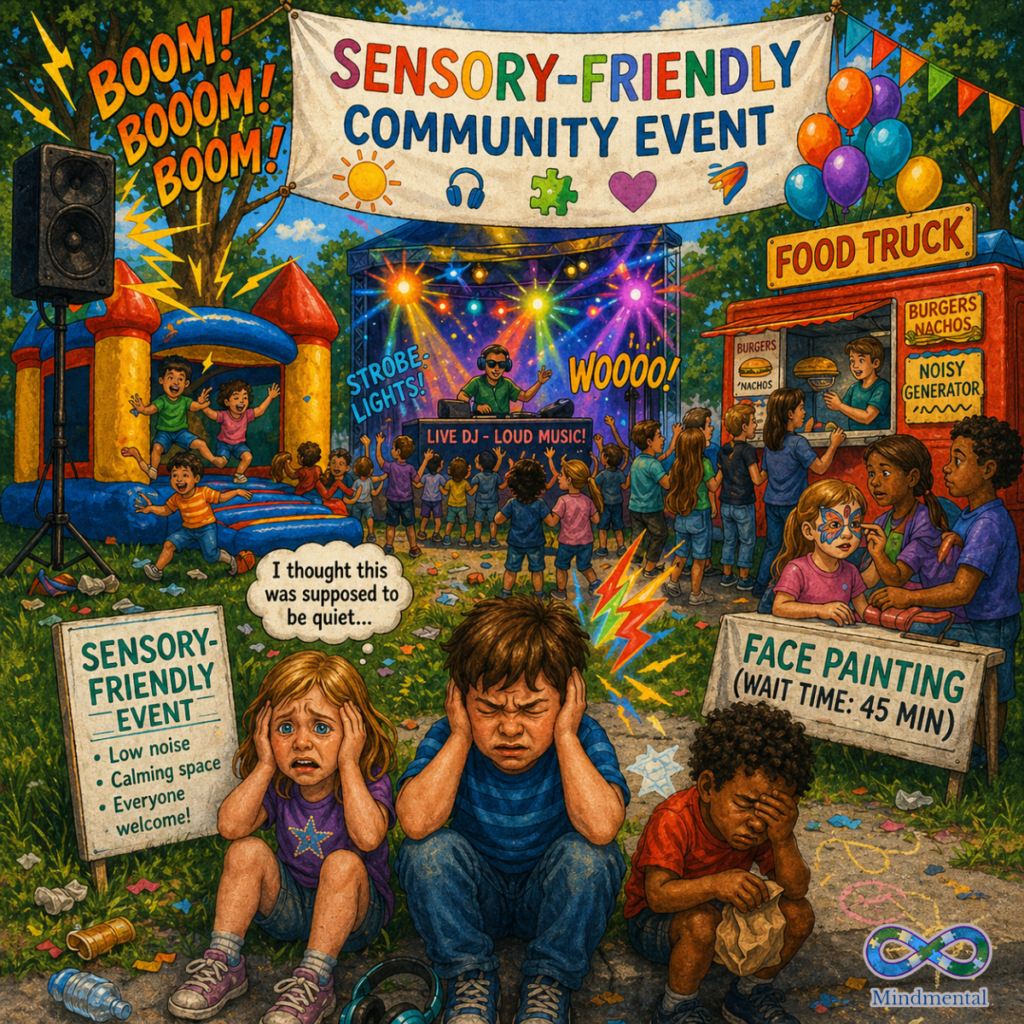
As Autism Awareness and Acceptance Month comes to a close, many communities proudly highlight their “sensory-friendly” events – spaces meant to welcome autistic children, neurodivergent families, and anyone who benefits from reduced sensory load.
But too often, what’s advertised as sensory-friendly ends up looking like the scene so many families know too well: booming speakers, flashing lights, long lines, crowded spaces, and overwhelmed children sitting on the curb wondering why the “quiet event” feels louder than a county fair.
This isn’t about blame. It’s about foresight. It’s about responsibility. And it’s about honoring the very people these events claim to serve.
When “Sensory-friendly” Becomes a Marketing Term
Let’s be clear:
Sensory-friendly is not a theme. It’s not a vibe. It’s not a marketing hook.
What sensory-friendly is NOT:
- Loud DJs “turned down a little”
- Bounce houses with blowers roaring
- One overwhelmed “quiet room” next to a generator
- Long, unpredictable wait times
- Hoping kids will “adjust”
What sensory-friendly is:
- Intentionally designed environments
- Predictable flow and reduced sensory load
- Staff trained to support neurodivergent needs
- Accessibility built in from the start
- A commitment to regulation, safety, and dignity
If the environment is built for the crowd first and the neurodivergent community second, it is not sensory-friendly.
“Inclusion without intention becomes exclusion in disguise.”
For Community Providers: If You Use the Term, Honor the Term
If you are hosting an event for autistic individuals, neurodivergent adults, or families with sensory needs, the label “sensory-friendly” carries weight. It signals safety, accessibility, and intentionality.
Reduce, Don’t Rebrand, Sensory Input
A sensory-friendly event cannot include:
- Loud DJs
- Strobe or flashing lights
- Generators humming beside food trucks
- Long, unstructured lines
- Overcrowded activity zones
If these elements are non-negotiable, the event is not sensory-friendly. Call it something else.
Build the Environment Around Regulation
A true sensory-friendly event includes:
- Low or no amplified sound
- Soft, natural lighting
- Predictable flow and clear signage
- Quiet zones that are actually quiet
- Sensory tools available (fidgets, headphones, weighted items)
These are not “extras.” They are accessibility features.
Safety for Elopers and Wanderers
This is one of the most overlooked areas and one of the most critical.
A sensory-friendly event must consider:
- Secured or clearly defined boundaries
- Staff positioned at exits
- Wristbands or ID systems
- Space for wagons, strollers, and mobility devices
- Multiple quiet areas so families don’t have to navigate crowds to regulate
If a child bolts toward an exit because they’re overwhelmed, there must be a plan.
Train Your Staff and Volunteers
A sensory-friendly event requires people who understand:
- Signs of dysregulation
- How to support without escalating
- How to communicate with low-language or non-speaking children
- How to respond to meltdowns with calm, not judgment
Training is not optional. It is part of accessibility.
For Parents & Caregivers: How to Evaluate Whether an Event Will Truly Meet Your Child’s Needs
Even with the best intentions, not every event will be the right fit for every child. Here are practical questions to help you assess whether a “sensory-friendly” event is actually accessible for your family.
Safety for Elopers
Ask or look for:
- Are wagons or strollers allowed?
- Is the space enclosed or open?
- Are exits monitored?
- Are staff trained on elopement?
If your child is an eloper, these details matter more than any activity offered.
Crowd Management
Consider:
- Is early entry available?
- Are there designated low-crowd hours?
- Are tickets capped or unlimited?
- Are wait times reasonable?
A “quiet hour” at 9 a.m. is very different from a “sensory-friendly” label slapped onto a midday festival.
Sibling Inclusion
Look for:
- Activities accessible to siblings
- Spaces where siblings can play safely
- Policies that allow wagons, snacks, or comfort items
If siblings are bored, overstimulated, or excluded, the whole family struggles.
Sensory Supports
Check whether the event offers:
- Noise – reduction headphones
- Fidgets or sensory kits
- Quiet rooms or calm – down spaces
- Staff trained in neurodiversity – affirming support
If none of these are mentioned, the event may not be prepared.
Quick Scan: Red Flags & Green Flags
🚩 Red Flags
- “Sensory-friendly” but includes DJs, bounce houses, or strobe lights
- No capacity limits
- One overwhelmed “quiet room”
- Staff who can’t answer basic questions
- “Just bring headphones if your child needs them”
✅ Green Flags
- Timed entry or limited capacity
- Multiple quiet zones
- Sensory supports provided
- Staff trained on sensory needs and elopement
- Clear signage and predictable layout
These small cues tell you everything about whether the event was designed with intention – or labeled for marketing.
“Families don’t need marketing language. They need environments built for regulation and safety.”
Closing Thoughts: Awareness Isn’t Enough – Design for Belonging
As we close out Autism Awareness and Acceptance Month, let’s move beyond blue lights and hashtags. Let’s move beyond labels that sound inclusive but fall apart in practice.
Families deserve events where their children can participate without fear, overwhelm, or exclusion. Providers deserve the tools and knowledge to create those spaces. And autistic individuals deserve environments built with their sensory needs – not the crowd’s entertainment – in mind.
Awareness is passive. Acceptance is active. Belonging is intentional.
And “sensory-friendly” should never be a marketing term. It should be a promise.
Let’s Connect
When we center experience, support becomes inclusive and cultivates belonging.
Email: hello@mindmental.co
Newsletter: Sign up to receive monthly highlights and resources
Blog: New posts weekly
Did you miss the Support without Labels article?
Follow me on LinkedIn and Facebook for more resources and real time updates!
Important Note: I am not a licensed therapist or counselor and I do not provide clinical mental health services. Mindmental offers educational resources, organizational tools, and community support based on professional experience and lived expertise. For clinical care, please contact a licensed provider.
© 2026 Mindmental. All rights reserved.