

Published by Mindmental | PTSD Awareness Month | June 2026
You have probably heard of fight or flight.
You may have even heard of freeze.
But if you are parenting a military child – especially one who is neurodivergent – there is a fourth response you need to know, and a fifth that science is beginning to name. Because what looks like defiance, withdrawal, clinginess, or total emotional collapse in your child may not be a behavior problem at all.
It may be their nervous system doing exactly what nervous systems are designed to do.
Understanding these responses does not just explain your child’s behavior. It changes how you respond to it. And as someone trained in certified anger management – where the nervous system’s role in the escalation cycle is foundational – I can tell you that this knowledge is genuinely one of the most powerful tools a parent can have.
1. The Nervous System Is Not Misbehaving. It Is Responding.
Before we name each response, it helps to understand what is happening underneath all of them.
Your child’s brain has a survival system that operates faster than conscious thought. When it detects a threat – real, perceived, or remembered – it activates an automatic response designed to protect them. This happens before they can think, decide, or choose how to act.
This system does not distinguish between a tiger and a parent who sounds angry. Between a combat zone and a school hallway that feels unpredictable. Between a real threat and a sensory environment that overwhelms a neurodivergent nervous system.
When we understand that, the behavior that looked like defiance starts to look different. The child who exploded was not choosing to rage. The child who shut down was not choosing to ignore you. Their nervous system made a decision on their behalf – and it made the only decision it knew how to make.
For military children, who have often experienced deployment cycles, reintegration, PCS moves, and household stress that registered in their bodies even when no one named it – this system has frequently been put to work. And a nervous system that has been working overtime for a long time develops patterns.
Those patterns are what we are about to name.
2. Fight: The Response That Looks Like the Problem
The fight response is the one that gets children sent to the principal’s office, labeled as aggressive, or disciplined before anyone asks what set them off.
When the nervous system detects threat and activates fight, it floods the body with cortisol and adrenaline. Heart rate accelerates. Muscles tense. The body prepares to confront what it perceives as danger.
In a child, this can look like:
- Explosive outbursts that seem disproportionate to what happened
- Hitting, kicking, or throwing
- Aggressive verbal responses – arguing, yelling, threatening
- Defiance that escalates when pushed
- Irritability that seems to be looking for a target
As someone trained in certified anger management, I want to be direct about something: anger is not the problem. The nervous system response underneath the anger is the information.
In the anger management framework, we understand that the escalation cycle has a physiological trigger phase that happens before the anger becomes visible. By the time a child is in an explosive moment, their nervous system has already been activated – often long before anyone noticed.
For military children, the fight response can be chronically activated by environments that feel unpredictable, relationships that feel uncertain, or transitions that have happened too many times without enough support. Their nervous system has learned that threat is always possible – and fight keeps them from being caught off guard.
What helps: Co-regulation before correction. A regulated adult nervous system is the most powerful tool for de-escalating a child in fight response. Not louder, not more forceful – calmer. The nervous system responds to felt safety, not to logic delivered during activation.
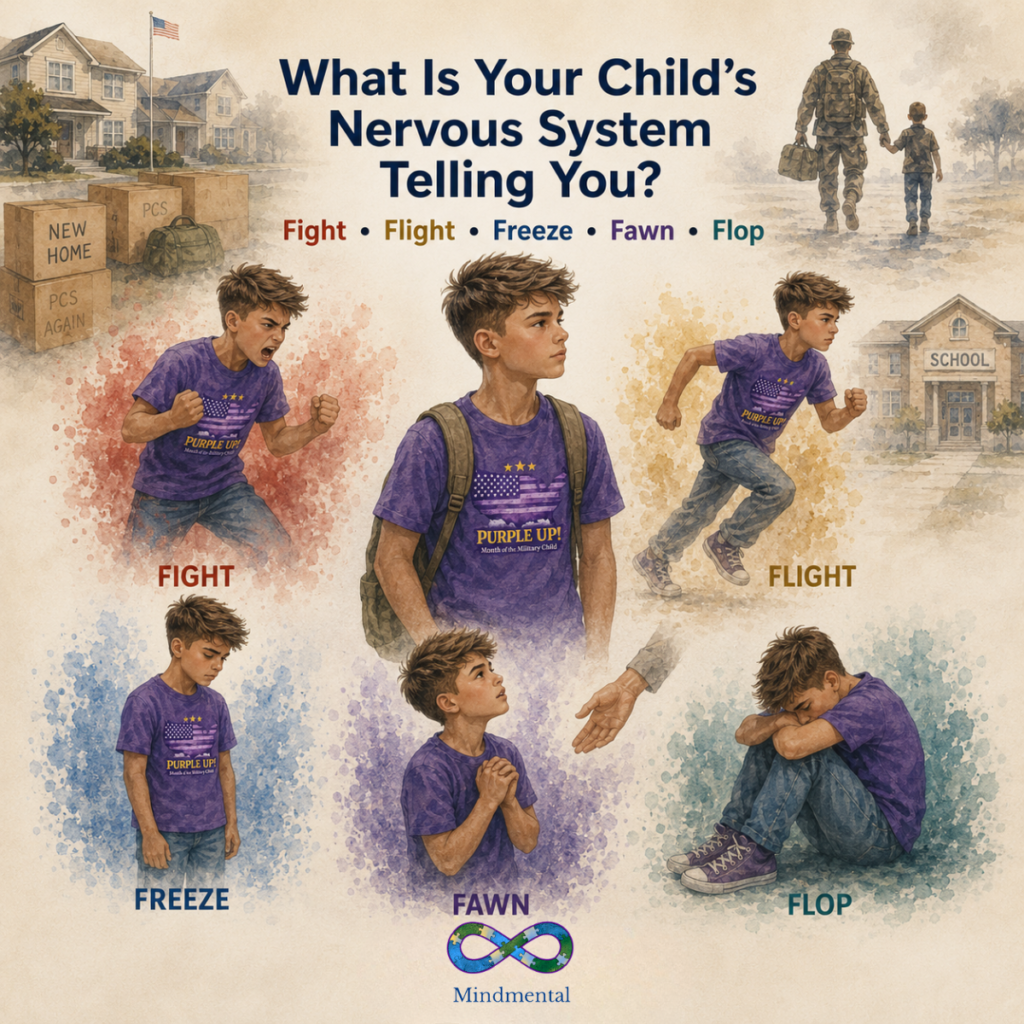
3. Flight: The Response That Looks Like Avoidance
Flight is the response that gets labeled as anxiety, avoidance, or “won’t engage.”
When fight does not feel possible or safe – or when the threat feels too large to confront – the nervous system may activate flight instead. The body prepares to escape, physically or mentally.
In a child, this can look like:
- Running away or physically leaving difficult situations
- Refusing to attend school, appointments, or activities
- Hyperactivity that is actually nervous energy with nowhere to go
- Overworking or overachieving to stay one step ahead of the feeling
- Overthinking, anxiety spirals, or constant worst-case scenarios
- Emotional or physical distraction when the moment feels too hard
For military children, flight can look like the child who is always “fine” – who has learned that the fastest way to get through hard things is to leave them behind. Every PCS move may have reinforced this: you cannot hold on to what you had, so you stop letting things matter.
This is not emotional immaturity. It is adaptation.
What helps: Consistency and predictability where possible. Flight-activated children need to feel that staying is safe – that the environment will not collapse on them if they let their guard down. This takes time and takes repetition.
4. Freeze: The Response That Looks Like Shutdown
Freeze is the response that gets missed the most – and misread the most often.
When neither fight nor flight feels possible, the nervous system can shift into freeze. The body becomes immobilized. The mind may feel foggy, distant, or absent. The child may appear to be doing nothing – but their nervous system is doing something very specific: it is pausing, scanning, and waiting.
In a child, this can look like:
- Staring blankly and not responding
- Going very still or rigid in stressful moments
- Difficulty answering questions or following instructions during activation
- Emotional numbness or appearing not to care
- Feeling paralyzed when making decisions under pressure
- Dissociation – appearing to “check out” of what is happening around them
For neurodivergent military children, freeze is particularly common and particularly misunderstood. A child in freeze during an IEP meeting, a classroom conflict, or a moment of household tension is not being dismissive. Their nervous system has hit a wall.
What helps: Reduce the demand in the moment. Lower your voice. Move slowly. Give the child time to come back before expecting a response. A freeze response cannot be interrupted by pressure – it can only be gently accompanied back to safety.
5. Fawn: The Response Nobody Talks About
Fawn is the fourth response – and the one most parents have never heard of, even though they may have been watching it for years.
When fight, flight, and freeze have not worked – or when a child has learned early that conflict is dangerous – the nervous system may activate fawn instead. The body responds to threat by attempting to appease it. To placate. To become whatever the perceived threat needs them to be.
In a child, this can look like:
- People-pleasing to an extreme degree
- Agreeing with everything, even when they clearly disagree
- Becoming the “easy” child – no needs, no complaints, no problems
- Over-apologizing or taking responsibility for things that are not their fault
- Being hyper-attuned to adult moods and adjusting their behavior accordingly
- Having difficulty identifying their own needs or preferences
For military children, fawn is often the response that gets praised. The child who is flexible across every PCS move. The child who never complains about dad being gone. The child who is always helpful, always agreeable, always “so mature for their age.”
That child may be carrying something significant that their nervous system decided was safer to hide.
The fawn response, when it becomes a pattern, can lead to difficulty setting boundaries, loss of sense of self, and deep vulnerability to relationships where others take advantage of their agreeableness.
What helps: Name their needs before they are asked to meet yours. Give them explicit permission to disagree. Make it safe to say “I don’t want to” without consequence. Fawn-patterned children need consistent evidence that their authentic self is welcome and safe.
6. A Nod to the Fifth: Flop and the Vagus Nerve
Emerging trauma-informed research is beginning to name a fifth response: flop.
Flop is grounded in Polyvagal Theory – the work of neuroscientist Stephen Porges – which maps how the vagus nerve regulates our nervous system’s movement between states of safety, mobilization, and shutdown.
When the nervous system has been activated beyond what it can sustain, it may enter a dorsal vagal shutdown state. Rather than mobilizing energy to fight, flee, or freeze, the body collapses. The muscles go limp. The mind may disconnect. The person may faint, dissociate deeply, or become completely unresponsive.
In children, subtle flop responses can look like suddenly being unable to think clearly, becoming socially withdrawn, or experiencing a drop in mood that seems to come from nowhere.
This is not formally named in clinical diagnostic frameworks yet – but it is grounded in accepted nervous system science and increasingly recognized in trauma-informed practice. For military and neurodivergent children whose nervous systems have been working hard for a long time, understanding that the vagus nerve can eventually shift into complete shutdown is important context for parents who have watched their child go from activated to completely flat – and did not know what they were seeing.
7. What This Means for Military and Neurodivergent Families
For military children, these responses are not random. They are the result of a nervous system that has been navigating real and significant stressors – deployment cycles, reintegration, PCS moves, household tension, and the emotional weight of a family under pressure.
For neurodivergent children, these responses are amplified by nervous systems that are already processing the world with more sensitivity, more intensity, and less margin for error.
When you see a behavior that looks like a problem – explosive, avoidant, frozen, compliant to the point of disappearing – the most powerful question you can ask is not “what is wrong with my child?” but “what is their nervous system responding to?”
That question changes everything.
8. Permission Statements for Parents Reading This
☐ Permission to stop interpreting your child’s response as a character flaw
☐ Permission to ask “what happened?” before “why did you do that?”
☐ Permission to recognize your own trauma responses – and understand they are communicating in the same language as your child’s
☐ Permission to slow down during activation instead of escalating
☐ Permission to not have known this before now – and to use it going forward
☐ Permission to be a regulated adult in an imperfect way, on an imperfect day, and still make a difference
What Comes Next
Next week we close the month with: “Finding Support When the System Wasn’t Built for You” – a resource guide for military families with neurodivergent children navigating PTSD and trauma, with honest commentary on where the gaps still exist and where to begin anyway.
Have you seen these responses in your child – or in yourself? Share in the comments. This community grows when we name things together.
The Purple Up shirt featured in this article’s artwork is available in the Mindmental Etsy shop – for military kids who carry more than most people see.

Mindmental creates trauma-informed, capacity-honoring resources for military families, neurodivergent households, and anyone navigating complex seasons of life. Built with lived experience. Backed by professional expertise. Designed for your reality.
This article is for informational and awareness purposes only. It draws on trauma-informed research and the author’s background in certified anger management. It is not intended to diagnose or replace professional mental health support. If you or your child are experiencing significant distress, please reach out to a qualified professional or someone you trust.
Did you miss the When Service Follows You Home: Understanding Secondary Trauma in Military Families
article?
Follow me on LinkedIn and Facebook for more resources and real time updates!
Let’s Connect!
Email: hello@mindmental.co
Newsletter: Sign up to receive monthly highlights and resources
Blog: New posts weekly