This is the final article in our June PTSD Awareness Month series.
All month we have named things that do not get named often enough. Secondary traumatic stress in military spouses. PTSD in parents of autistic children. The trauma that military kids carry without anyone calling it trauma. Caregiver fatigue that goes so deep it rewires a nervous system.
Now comes the part where we talk about what to do with all of that.
And we are going to be honest with you – the way we have been all month.
The support landscape for military families navigating PTSD alongside neurodivergent needs is genuinely inadequate. The gaps are real, the waitlists are long, and the resources that do exist were largely built for one part of your family’s experience at a time – not the intersection of all of it.
That does not mean there is nothing. It means you need to know where to look, what to expect, and where the limitations are before you spend precious capacity chasing something that will not actually help you.
This guide gives you that.
1. For the Service Member or Veteran
National Center for PTSD – VA ptsd.va.gov
The most comprehensive PTSD-specific resource available for veterans and service members. Includes evidence-based information on symptoms, treatment options, and self-help tools. The PTSD Coach app – free – is genuinely useful for symptom tracking and in-the-moment coping tools.
Veterans Crisis Line Dial 988, then press 1 | Text 838255 | veteranscrisisline.net
For moments of crisis. Available 24/7. Confidential.
Honest note: This is a crisis resource, not an ongoing support system. It is not a substitute for consistent therapeutic support – but it is an important safety net.
2. For Military Spouses and Family Members
Military OneSource militaryonesource.mil | 1-800-342-9647
Offers up to 12 free confidential counseling sessions for non-clinical issues, including stress, relationship challenges, and adjustment difficulties. Available to active duty, Guard, and Reserve families. Telehealth options available.
Honest note: Please note 12-session limit. For complex, ongoing trauma – secondary traumatic stress, caregiver PTSD – 12 sessions is a starting point, not a solution. Use it to access support while you identify longer-term options.
TRICARE Mental Health Services tricare.mil/mentalhealth
Covers mental health services for eligible family members, including spouses. Telehealth options have expanded significantly and are particularly valuable during PCS transitions when local providers are unavailable.
Honest note: Coverage exists but provider availability varies enormously by location. Start this search earlier than you think you need to.
Give an Hour giveanhour.org
Network of licensed mental health professionals who provide free mental health care to military families. Quality varies by provider but the network is geographically broad.
3. For Military Families with Neurodivergent Children
Exceptional Family Member Program (EFMP) Available through your installation’s Family Support Services
EFMP enrollment is the starting point for accessing specialized support services for military families with special needs family members. Enrollment connects you to EFMP Family Support, which can help navigate resources at your duty station.
Honest note: EFMP resources varies by installation.
Autism Care Demonstration (ACD) – TRICARE tricare.mil/autism
Provides Applied Behavior Analysis (ABA) and other autism-specific services for TRICARE-covered families. Available to active duty and some other TRICARE beneficiaries.
Honest note: ABA is covered but families have mixed experiences with it as a therapeutic approach. Know what your child needs and advocate for it within the program. Coverage does not guarantee the right fit.
Military Homefront – Special Needs Resources militaryonesource.mil/special-needs
A starting point for navigating special needs resources within the military system. Connects to EFMP and other support services.
Honest note: This is a navigation tool, not direct support.
4. For Caregiver Mental Health Specifically
NAMI Helpline nami.org | 1-800-950-6264
National Alliance on Mental Illness. Offers information, referrals, and peer support for individuals and families navigating mental health challenges. Not military-specific but knowledgeable and accessible.
Honest note: This resource offers non-military-specific resources for caregivers, helpful for family members.
Caregiver Action Network caregiveraction.org
Resources specifically for family caregivers across a range of caregiving contexts. Includes peer support and education.
Honest note: Not military or neurodivergent-specific, but the caregiver fatigue content is solid and validating for parents who have never had their own experience named.
SAMHSA National Helpline 1-800-662-4357 | samhsa.gov
Free, confidential, 24/7 treatment referral and information service. Can help connect to local mental health and substance use resources.
Honest note: A referral service, not direct support. Useful for finding local options when you do not know where to start.
5. For Peer Connection – The Resource the System Underestimates
Research consistently shows that peer connection – talking to someone who actually understands your specific experience – is one of the most meaningful protective factors for military families navigating neurodivergent needs and trauma.
The formal system rarely centers this. Here are verified organizations that do:
National Military Family Association (NMFA) militaryfamily.org
A nonprofit operating since 1969, dedicated to identifying and solving the challenges of military life. NMFA provides resource guides specifically for military families with special needs dependents, along with peer engagement programs and advocacy for gaps in mental health services and respite care.
Honest note: NMFA is a strong advocacy and resource organization. Best utilized to find guides, links, and programs.
EFMP Family Support Groups Available through your installation’s EFMP Family Support office or militaryonesource.mil
Many installations host peer groups specifically for families with exceptional family members. Connect through your EFMP Family Support point of contact or Military OneSource’s special needs resources page.
Honest note: Availability and quality vary significantly by installation, the same way other EFMP resources do. Ask directly – these groups are not always advertised proactively.
Autism Society of America – Military and Veteran Families autism-society.org
A national nonprofit with chapters and resources specifically addressing the intersection of military life and autism. Offers webinars, resource guides, and community connection points.
Honest note: Offers national resources and webinars.
A note on what we are not including: Several informal online communities for military and neurodivergent families exist and provide genuine, real-time peer support. Because they operate outside of any verifiable organizational structure, we are not listing them here – but searching for these communities through your preferred platform remains a valid and often valuable option for finding people who understand your specific experience.
6. In a Crisis
988 Suicide and Crisis Lifeline Call or text 988
Veterans Crisis Line Dial 988, press 1 | Text 838255
Crisis Text Line Text HOME to 741741
If you or someone in your household is in immediate danger, call 911.
The Honest Summary
The system was not built for the intersection of military life and neurodivergent needs. It was not built for the caregiver who is also a trauma survivor. It was not built for the family that moves every two years and has to start over every time.
That does not mean you give up. It means you go in knowing what you are working with.
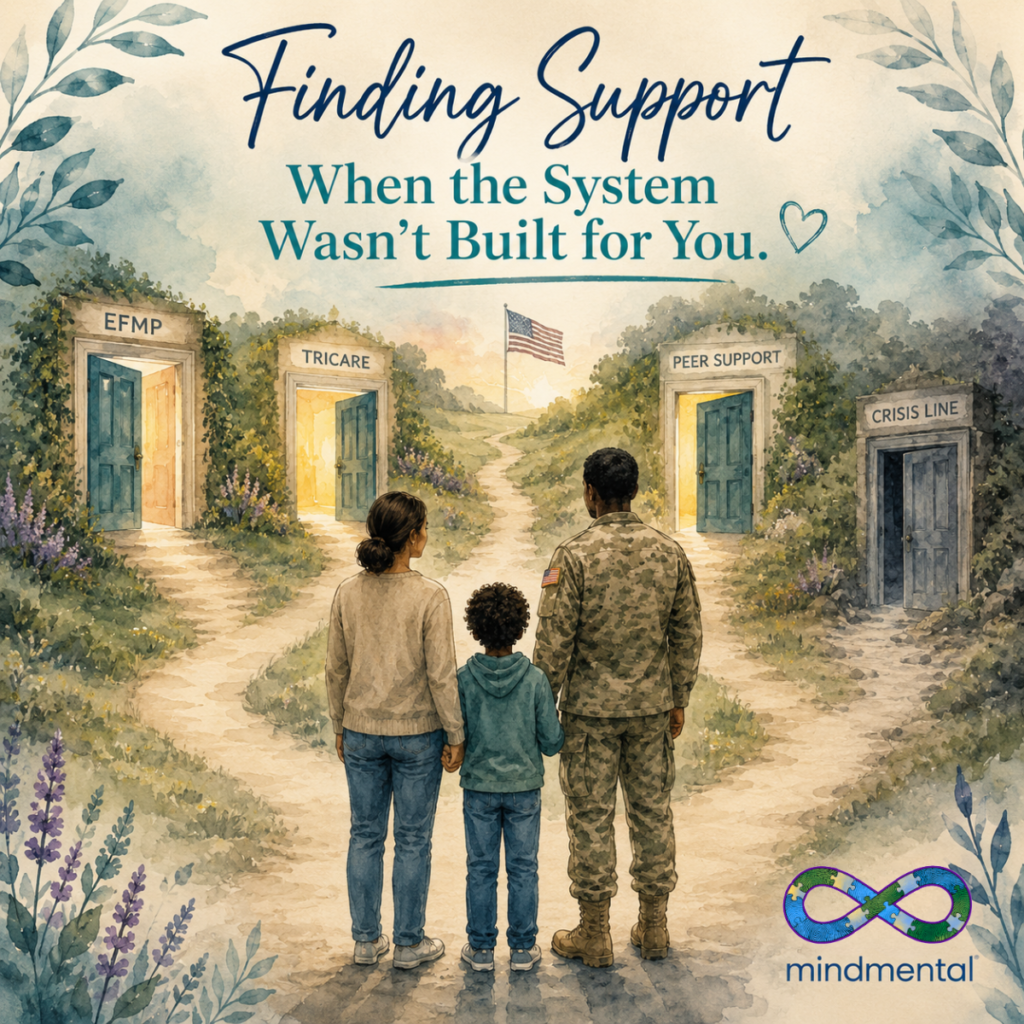
Start with what is accessible. Military OneSource for immediate support. TRICARE for ongoing care. EFMP for specialized navigation. Peer community for the parts the formal system cannot reach.
Advocate loudly. Document everything. And give yourself credit for doing this work in a system that makes it harder than it should be.
You are not failing at accessing support. The support is failing to meet you where you are. There is a significant difference – and naming it matters.
What This Month Was About
June gave us space to name things that rarely get named:
The spouse who carries the household through deployment and calls it fine. The parent whose nervous system developed its own trauma response. The child who absorbed the weight of a stressed household without anyone realizing it. The caregiver who has been running on empty for so long that empty became the baseline.
PTSD Awareness Month is 30 days. The reality it points to does not pause on July 1.
Mindmental will keep showing up for these families – not just in June, but in every resource, every article, and every tool we build.
Because this community deserves support that was actually designed for their reality.
Was there a resource that helped your family that we did not include? Leave it in the comments. This community grows when we share what actually works.
Mindmental creates trauma-informed, capacity-honoring resources for military families, neurodivergent households, and anyone navigating complex seasons of life. Built with lived experience. Backed by professional expertise. Designed for your reality.
This resource guide is for informational purposes only. It is not a clinical referral or endorsement of any specific provider or program. Always verify current availability and eligibility for any resource listed. If you or your family are experiencing significant distress, please reach out to a qualified professional or someone you trust.
Let’s Connect
Email: hello@mindmental.co
Newsletter: Sign up to receive monthly highlights and resources
Blog: New posts weekly