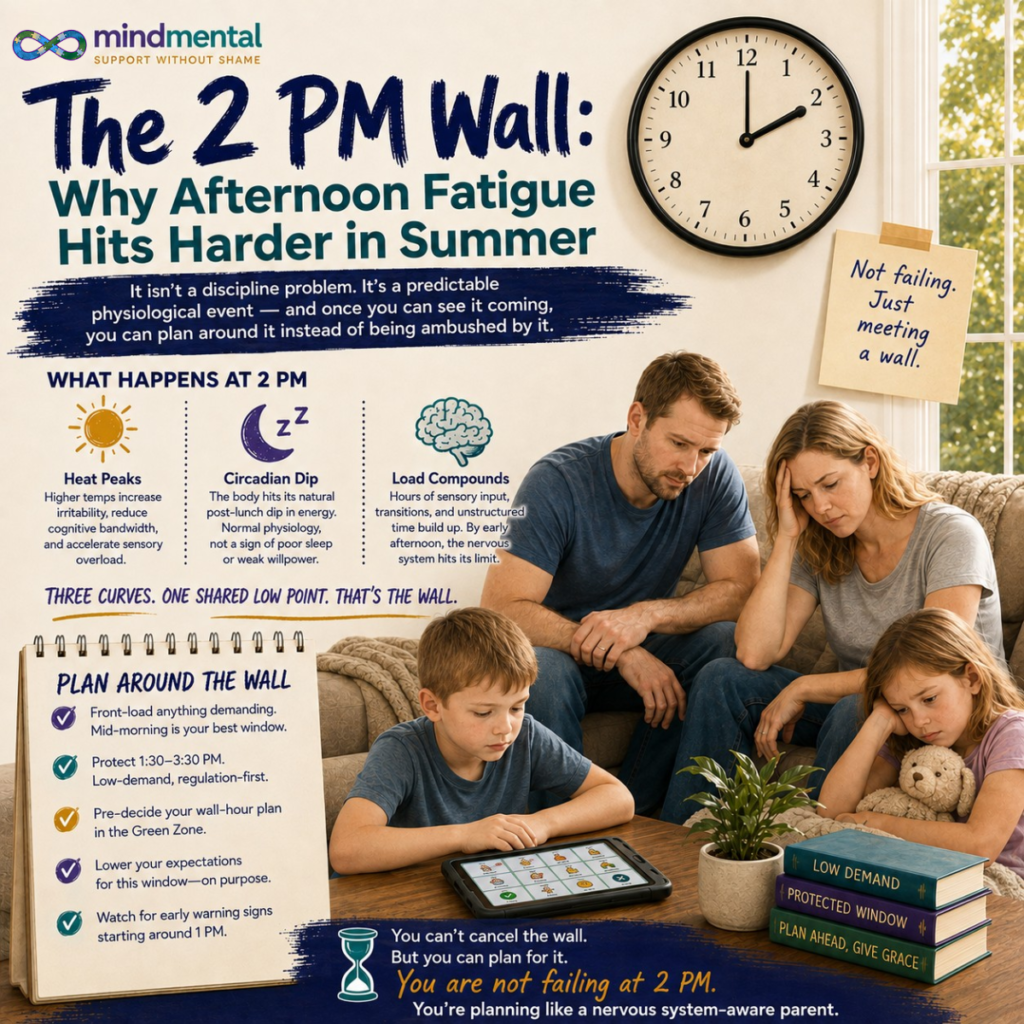
The 2 PM Wall: Why It Happens, Why It’s Predictable, and Why It Isn’t Your Fault
It isn’t a discipline problem. It’s a predictable physiological event, and once you can see it coming, you can plan around it instead of being ambushed by it.
By the time Part 2 introduced capacity mapping, one pattern kept surfacing in the re‑mapping step. Something happens around 2 PM.
Energy drops. Patience thins. Sensory tolerance collapses. A morning that felt manageable turns into an afternoon that feels impossible, and it happens on a schedule reliable enough to set a clock by.
Most parents interpret this as a personal failing. I should have more energy than this. I should be able to hold it together a few more hours.
It isn’t a personal failing. It’s physiology, and it has a name.
What Actually Happens at 2 PM
Three separate curves peak at almost exactly the same time in the summer afternoon, and none of them are within a parent’s control.
- Heat peak
Early to mid afternoon is when ambient temperature crests. Heat doesn’t just make people uncomfortable. It measurably increases irritability, reduces cognitive bandwidth, and accelerates sensory overload in both kids and adults. - Circadian energy dip
The human body has a natural post lunch drop in alertness, sometimes called the afternoon trough. It is a normal part of circadian rhythm, not a sign of poor sleep or weak willpower. - Accumulated sensory load
By early afternoon, a child has absorbed hours of summer’s sensory input. Heat, noise, transitions, unstructured time. Dysregulation doesn’t appear out of nowhere at 2 PM. It has been building since breakfast, and early afternoon is when the total finally exceeds what the nervous system can hold.
Three separate curves, one shared low point. That is the wall.
Why This Hits Different in Summer
During the school year, early afternoon usually finds kids in a structured environment designed around their needs. The 2 PM dip still happens because it is physiological, but school absorbs some of the impact by keeping variables predictable.
Summer removes that scaffolding.
There is no structured setting holding steady while energy dips. Instead, families are often out in the heat, mid activity, away from home, with no built in reset at the exact hour capacity is lowest.
For military families, the load compounds further. Solo parenting during TDY or deployment. Navigating a new duty station. Operating without an established routine. There is no second adult to tag in when the wall hits.
What the Wall Actually Looks Like
Common patterns include:
- Sudden child dysregulation over something small
- A parent who was patient at 10 AM snapping by 2:30
- Outings that were fine abruptly falling apart
- A spike in sensory complaints, clothes, noise, light, textures
- An overwhelming urge to get everyone home
If this sounds familiar, that recognition is the point. Once a pattern is named, it stops feeling random.

Planning Around the Wall Instead of Being Ambushed By It
You cannot cancel the wall. You can build your day so it doesn’t catch you off guard.
- Front load demanding tasks
Mid morning is a better window for anything requiring regulation or patience. - Treat 1:30 to 3:30 PM as a protected low demand window
Home based regulation, screen time without guilt, quiet parallel play, or simply lower expectations. - Pre decide your wall hour plan
Decide in the morning what 2 PM will look like. Don’t wait until you are already dysregulated. - Lower your expectations on purpose
Afternoon you is not morning you. Plan accordingly. - Watch for early warning signs
Rising volume, shorter fuses, sensory complaints, repetitive questions. Catching it early gives you room to downshift.
The Non Obvious Insight
The 2 PM Wall isn’t evidence that you are doing summer wrong. It is evidence that you are a person with a nervous system, parenting other people with nervous systems, in a season that removes the scaffolding that normally absorbs this predictable dip.
Parents often blame themselves for the afternoon crash. But self blame doesn’t change a physiological curve. Planning around it does.
You are not failing at 2 PM. You are meeting a wall that was always going to be there, and now you know exactly when it is coming.

What’s Next
Knowing the wall is coming solves half the problem. The other half is what to do with the smaller windows of connection and engagement that remain once energy is low. That is exactly what Part 4 covers. Interest Anchored Micro Moments, and why five focused minutes can do more than an hour of forced togetherness.
What This Series Will Cover
Over the next several weeks, this series will break down specific summer capacity pressure points and give you realistic, capacity-aligned strategies for each one.
- Part 1: The Truth About Summer Capacity
- Part 2: Understanding Summer Capacity Mapping (Last week’s article)
- Part 3: The 2 PM Wall: Why It Happens during the Summer (You are reading now)
- Part 4: Interest-Anchored Micro-Moments – how to use short windows of connection when longer ones aren’t possible
- Part 5: When the Plan Falls Apart – the permission and protocol to pivot without guilt
Each installment gives families a realistic strategy that doesn’t rely on wishful thinking, “push through it” culture, or the summer parent fantasy that leaves everyone feeling behind.
Before You Keep Going
If reading this spoke to you, then that’s the recognition of finally being seen in a season that has been quietly draining you.
You aren’t behind. You aren’t failing at summer.
You’re navigating a season your nervous system was never designed to sprint through.
The rest of this series will help you stop sprinting.
Let’s Connect
When we center experience, support becomes inclusive and cultivates belonging.
Email: hello@mindmental.co
Newsletter: Sign up to receive monthly highlights and resources
Blog: New posts weekly
Did you know we have an Etsy Shop? Check it out and wear your capacity!
Follow me on LinkedIn and Facebook for more resources and real time updates!