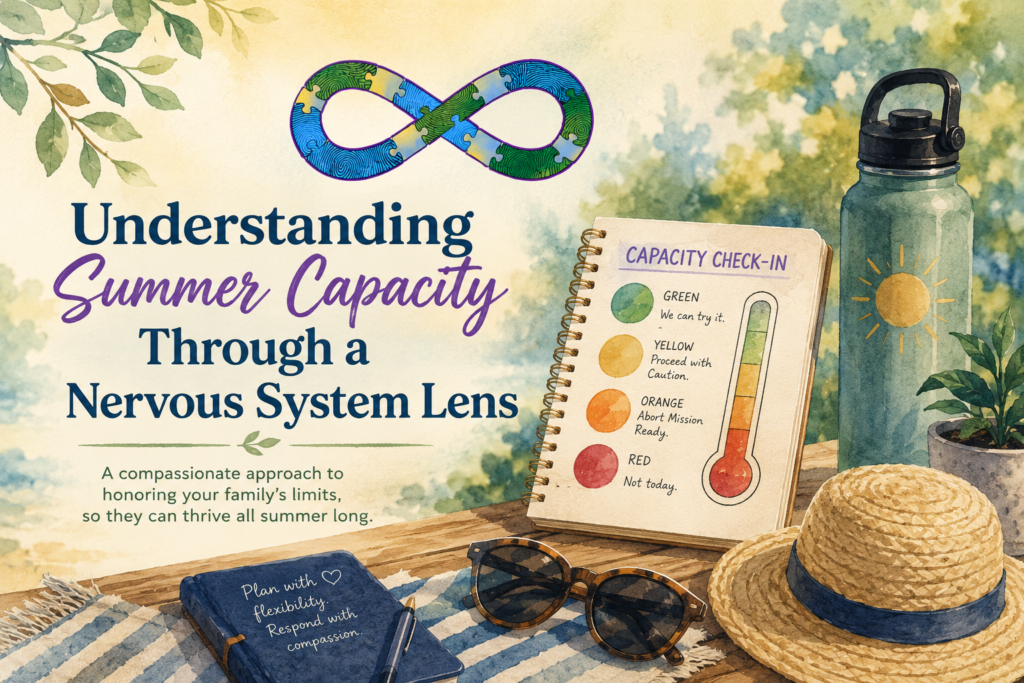
You don’t need to do less this summer. You need a way to know, day by day, what your family’s nervous system can actually hold within your family’s capacity.
Part 1 of this series named something most summer content ignores: summer doesn’t add capacity, it subtracts it. Heat, unpredictability, schedule disruption, and constant vigilance all draw from the same limited well.
So what do you do with that information?
You map it.
Summer Capacity Mapping is the practice of identifying your actual bandwidth in real time – not the bandwidth you wish you had, not the bandwidth other families seem to have, but the bandwidth actually available to you today.
If you woke up in a Yellow Zone, a pool day becomes a mismatch before you’ve even packed the bag. Knowing that before you leave the house is the whole point.
It’s not about doing less. It’s about doing what fits.
Why Summer Needs a Different Kind of Map
Every season asks something different of a family’s nervous system. Summer’s demands are distinct:
- Heat Load – heat drains energy, increases irritability, and accelerates sensory overload
- Environmental Chaos – crowds, noise, transitions, and outdoor unpredictability multiply
- Schedule Disruption – the structure school provided is gone, and the replacement rarely holds
- Safety Load – elopement risk increases in open spaces, water areas, and unfamiliar environments
- Parent Fatigue – heat and vigilance drain adult regulation faster than usual, not just adult energy
Your baseline capacity doesn’t stay constant through all of this. Summer compresses it. A capacity map helps you see by how much, on any given day, before you plan around a version of yourself that isn’t available.

The Summer Capacity Map: Four Zones
Think of your bandwidth in four zones. Each one represents a different level of energy, regulation, and risk tolerance – and each one calls for a different kind of day.
🟢 Green Zone – “We Can Try Something”
You have moderate energy, a child with relatively predictable behavior, manageable sensory load, and low elopement risk.
Green Zone activities: short outings, interest-aligned activities, shaded outdoor time, familiar environments.
🟡 Yellow Zone – “Proceed With Caution”
Energy is limited, sensory load is rising, irritability is present, and vigilance is climbing.
Yellow Zone activities: micro-outings, drive-through treats, water play at home, a sensory break in the car.
🟠 Orange Zone – “Abort Mission Ready”
Energy is low, sensory load is high, behavior is unpredictable, and elopement risk is elevated.
Orange Zone activities: home-based regulation, quiet play, interest-anchored tasks, an early bedtime wind-down.
🔴 Red Zone – “Nope. Not Today.”
Energy is depleted, shutdown or meltdown risk is real, conditions feel unsafe, and there is zero tolerance for the unexpected.
Red Zone activities: rest, recovery, minimal demands, a low-stimulus environment.
Mapping your day starts with naming which zone you’re in – before you plan a single thing.
Most overwhelm doesn’t come from a bad plan. It comes from a mismatched one – a Green Zone itinerary launched on an Orange Zone morning, with everyone wondering an hour in why it’s falling apart.

How to Map Your Capacity in Real Time
Step 1: Assess Your Baseline Each Morning
Ask yourself: How did I sleep? How hot is it today? What’s my emotional bandwidth? What’s my child’s regulation level right now? This sets your starting zone.
Your baseline may already be lower in July than it was in May. Cumulative heat exposure and weeks without school structure both take a toll – the zone you start from in week one isn’t the same zone you’ll start from in week six.
Step 2: Identify Today’s Load Factors
Heat index. Crowds. Transitions. Sensory triggers. Workday demands. Safety risks. Each one subtracts from what you’re starting with.
Step 3: Choose Activities That Match Your Zone
Green Zone plans don’t belong in a Yellow Zone day. Misalignment – asking your Tuesday self to execute your Saturday-morning plan – is where overwhelm sneaks in.
Step 4: Pre-Decide Your Backup Plan
This is what prevents the panic pivot. A backup plan should be shorter, safer, lower sensory load, and interest-aligned – decided before you need it, not scrambled together in the parking lot.
Step 5: Re-Map at 2 PM
Heat peaks. Fatigue peaks. Sensory load peaks. Your zone often drops a full level by mid-afternoon. Re-mapping here is what prevents the evening meltdown – and Part 3 breaks down exactly why this specific hour hits so predictably, and what to do before it takes the evening down with it.

The Non-Obvious Insight
Summer capacity isn’t about how much you want to do. It’s about how much your nervous system can hold before tipping into overwhelm, shutdown, or unsafe conditions.
When you map capacity instead of guessing at it:
- guilt decreases
- safety increases
- meltdowns reduce
- evenings stabilize
- outings become more predictable
- your child trusts transitions more
- you start trusting your own read of the day
Capacity mapping isn’t restriction. It’s clarity – and clarity is what builds trust, for your child and for yourself.
A Simple Daily Template
Summer Capacity Map – Daily Check
- Baseline Zone: Green / Yellow / Orange / Red
- Load Factors Today: (heat, crowds, transitions, fatigue, safety)
- Primary Plan: (activity that matches your zone)
- Backup Plan: (shorter, safer, lower sensory load)
- Abort Mission Trigger: (the moment you pivot)
- Evening Zone: Green / Yellow / Orange / Red
- Reset Plan: (regulation activity)
Your Evening Zone often differs from your Baseline Zone. Naming both – separately – prevents the evening meltdown from feeling like a surprise. It rarely is.
Save this. Screenshot it. Turn it into a sticky note on the fridge. This becomes muscle memory faster than you’d expect – most parents report using it without thinking by the second week.
What’s Next
Part 3 takes a closer look at one specific pattern this map keeps surfacing: the 2 PM Wall. Parents often blame themselves for the afternoon crash – but it’s physiological, not personal. Next time, we’ll unpack why it hits so hard in summer, and what to actually do about it before it takes the evening down with it.
What This Series Will Cover
Over the next several weeks, this series will break down specific summer capacity pressure points and give you realistic, capacity-aligned strategies for each one.
- Part 1: The Truth About Summer Capacity (Last week’s article)
- Part 2: Understanding Summer Capacity Mapping (You are reading now)
- Part 3: The 2 PM Wall – why afternoon fatigue hits harder in summer and how to plan around it
- Part 4: Interest-Anchored Micro-Moments – how to use short windows of connection when longer ones aren’t possible
- Part 5: When the Plan Falls Apart – the permission and protocol to pivot without guilt
Each installment gives families a realistic strategy that doesn’t rely on wishful thinking, “push through it” culture, or the summer parent fantasy that leaves everyone feeling behind.
Before You Keep Going
If reading this spoke to you, then that’s the recognition of finally being seen in a season that has been quietly draining you.
You aren’t behind. You aren’t failing at summer.
You’re navigating a season your nervous system was never designed to sprint through.
The rest of this series will help you stop sprinting.
Let’s Connect
When we center experience, support becomes inclusive and cultivates belonging.
Email: hello@mindmental.co
Newsletter: Sign up to receive monthly highlights and resources
Blog: New posts weekly
Did you know the shirt featured in in our Etsy Shop? Check out our selection!
Follow me on LinkedIn and Facebook for more resources and real time updates!