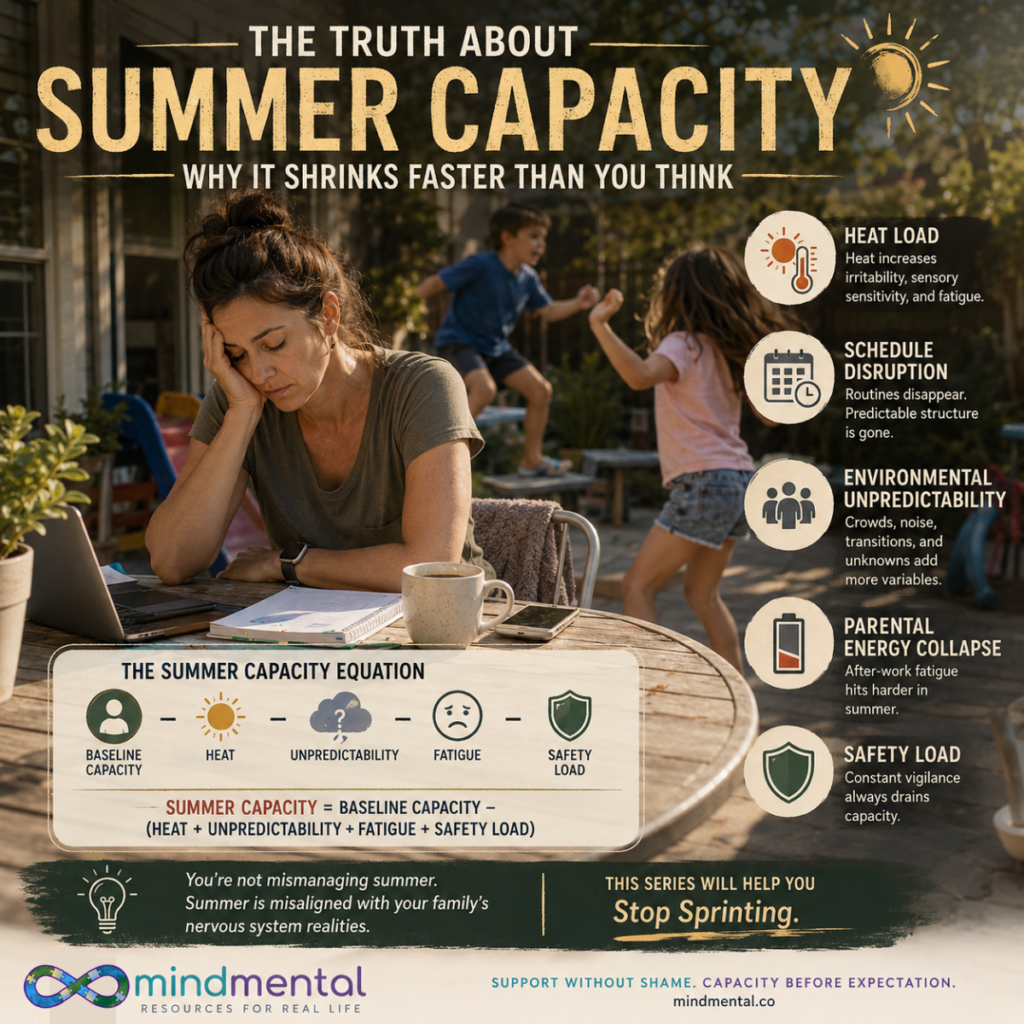
Summer looks expansive on paper – longer days, flexible schedules, “more time.” But for military and neurodivergent families, summer capacity often shrinks, not expands it.
Summer is sold to parents as the season of freedom.
More daylight. Fewer schedules. Room to breathe.
But if you’re raising a neurodivergent child, solo parenting through a deployment, mid-PCS with boxes still stacked in your living room, or navigating all three at once, you already know the truth:
Summer doesn’t add capacity. It quietly subtracts it.
This isn’t a failure of planning. It isn’t a failure of trying hard enough. It’s a failure of expectation alignment – the gap between what summer promises and what summer actually does to your nervous system.
What Summer Actually Does to Capacity
Summer introduces four bandwidth-draining forces that most families underestimate.
Heat Load. Heat doesn’t just make you uncomfortable. It increases irritability, dehydration, sensory sensitivity, and fatigue. It shortens fuses – yours and your child’s. It amplifies every other stressor already in the system.
Schedule Disruption. School routines disappear overnight. The predictable structure that regulated your child’s nervous system for nine months is gone, and whatever you build to replace it is rarely as consistent as the school year. For nervous systems that depend on predictability, this alone can throw everything off.
Environmental Unpredictability. Crowds, noise, smells, transitions, outdoor variables, unfamiliar spaces – summer multiplies sensory input. Every outing carries more variables than a winter afternoon at home ever would.
Parental Energy Collapse. After-work fatigue hits harder in summer. Heat drains adults too. The parent trying to hold everything together is running on a smaller battery, faster.
Capacity isn’t just how much you can do. It’s how much your nervous system can hold before tipping into overwhelm.

The Military Family Layer
For military families, summer piles on pressures that most summer content ignores entirely.
Peak PCS season falls in June and July – which means many families are moving, unpacking, or adjusting to a new duty station in the middle of the hottest, most unpredictable months of the year.
Deployment cycles don’t pause for summer break. Solo parenting a neurodivergent child through 90-plus-degree days with no school scaffolding and no local support is a specific kind of exhausting that civilian summer content rarely names.
New duty stations mean no established summer camps, no known providers, no reliable childcare, and no community you’ve had time to build. You’re doing summer from scratch – again.
Add all of this to the four forces above, and it’s not surprising you’re tired by 2 PM. It’s math.
The Hidden Load of Community Events
Summer is full of community events that look like gifts on paper: library summer reading programs, community center kids’ activities, splash pad meetups, neighborhood block parties, free concerts in the park, food truck nights, church picnics, holiday celebrations.
For most families, these are supposed to be the easy wins of summer.
For neurodivergent families, they carry a hidden load most planners don’t account for.
Community events are often volunteer-run, which means the schedule shifts, the setup changes, the “start time” isn’t really the start time, and the promised activities may or may not happen. What was advertised as face painting from 2 to 4 PM might actually be a 45-minute wait behind an overwhelmed volunteer who ran out of supplies.
For a nervous system that regulates on predictability, “we don’t really know what to expect” isn’t a small caveat. It’s the whole problem.
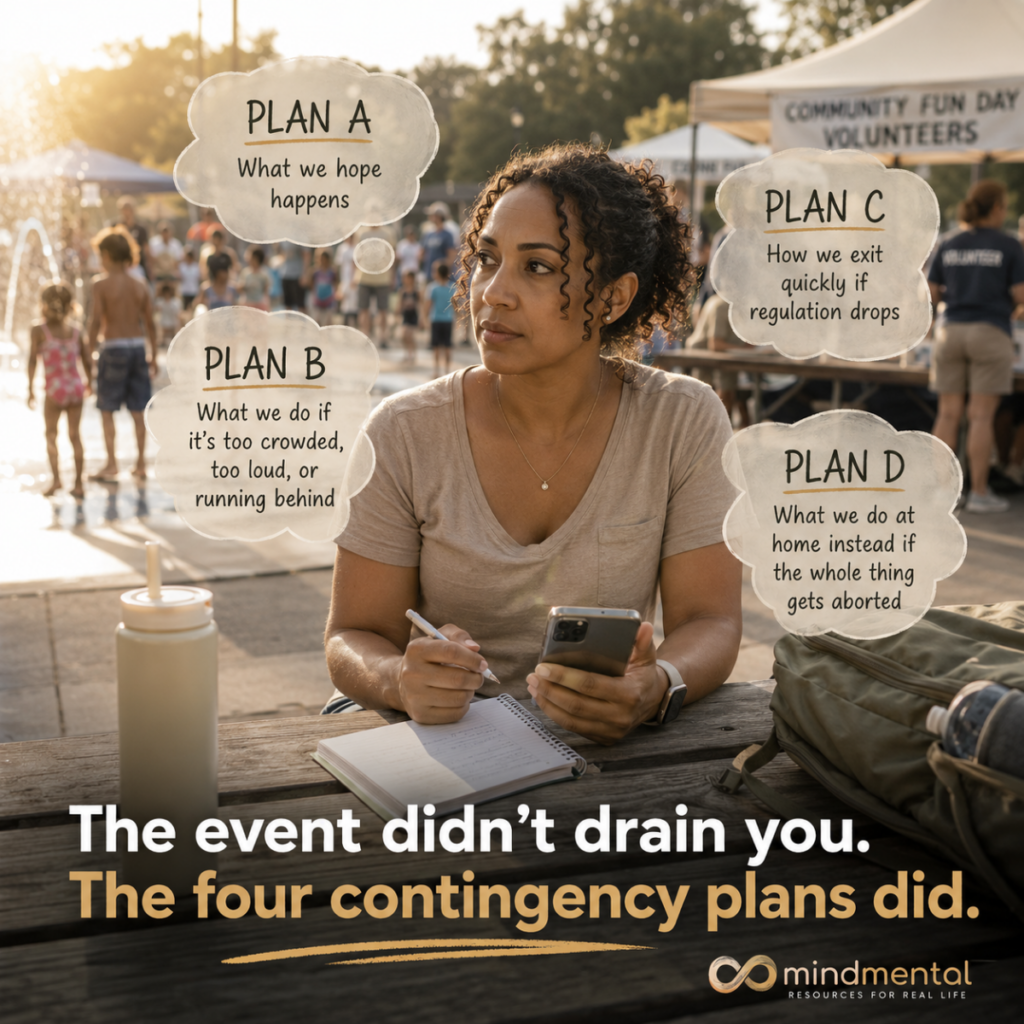
Which means before every community event, you’re not just packing a bag. You’re pre-planning:
- Plan A: What we hope happens
- Plan B: What we do if it’s too crowded, too loud, or running behind
- Plan C: How we exit quickly if regulation drops
- Plan D: What we do at home instead if the whole thing gets aborted
That’s four scenarios your nervous system is holding open before you’ve even left the house. Multiply that by every “fun” summer event on the calendar and the invisible planning load alone can burn through your capacity before anyone puts on sunscreen.
This is why some parents feel more tired after a “fun” community day than after a regular one at home.
The event didn’t drain you.
The four contingency plans did.
Why Neurodivergent Families Feel This More Intensely
Summer removes the scaffolding neurodivergent children rely on:
- predictable transitions
- controlled environments
- consistent sensory input
- structured expectations
- safe zones with low elopement risk
When that scaffolding disappears, parents step in to compensate – constantly. Constant vigilance drains capacity faster than any single outing or meltdown ever could.
This is why you can spend a whole day “doing nothing” and still feel wrung out by dinner.
The Summer Capacity Equation
Here’s the framework in one line:
Summer Capacity = Baseline Capacity − (Heat + Unpredictability + Fatigue + Safety Load)
Most parents assume summer adds capacity because there’s “more time.” Mathematically, it doesn’t. Every variable on the right side of that equation subtracts from what you actually have available.
You aren’t imagining that everything feels harder. It is harder.
The Non-Obvious Insight
Summer doesn’t just change what you can do – it changes how quickly you burn through capacity.
This is why:
- outings feel harder
- transitions feel heavier
- meltdowns happen faster
- interest drops quicker
- elopement risk increases
- guilt spikes
- parents feel “behind” even when they’re doing everything right
You’re not mismanaging summer. Summer is misaligned with your family’s nervous system realities.
That misalignment isn’t a personal failing. It’s a design problem- which can be solved with the right framework, not more willpower.
What This Series Will Cover
Over the next several weeks, this series will break down specific summer capacity pressure points and give you realistic, capacity-aligned strategies for each one.
- Part 1: The Truth About Summer Capacity ( You are reading now!)
- Part 2: Summer Capacity Mapping – the four-zone tool for matching activities to your actual bandwidth
- Part 3: The 2 PM Wall – why afternoon fatigue hits harder in summer and how to plan around it
- Part 4: Interest-Anchored Micro-Moments – how to use short windows of connection when longer ones aren’t possible
- Part 5: When the Plan Falls Apart – the permission and protocol to pivot without guilt
Each installment gives families a realistic strategy that doesn’t rely on wishful thinking, “push through it” culture, or the summer parent fantasy that leaves everyone feeling behind.
Before You Keep Going
If reading this spoke to you, then that’s the recognition of finally being seen in a season that has been quietly draining you.
You aren’t behind. You aren’t failing at summer.
You’re navigating a season your nervous system was never designed to sprint through.
The rest of this series will help you stop sprinting.
Let’s Connect
When we center experience, support becomes inclusive and cultivates belonging.
Email: hello@mindmental.co
Newsletter: Sign up to receive monthly highlights and resources
Blog: New posts weekly
Did you miss the Support without Labels article?
Follow me on LinkedIn and Facebook for more resources and real time updates!
Important Note: I am not a licensed therapist or counselor and I do not provide clinical mental health services. Mindmental offers educational resources, organizational tools, and community support based on professional experience and lived expertise. For clinical care, please contact a licensed provider.