
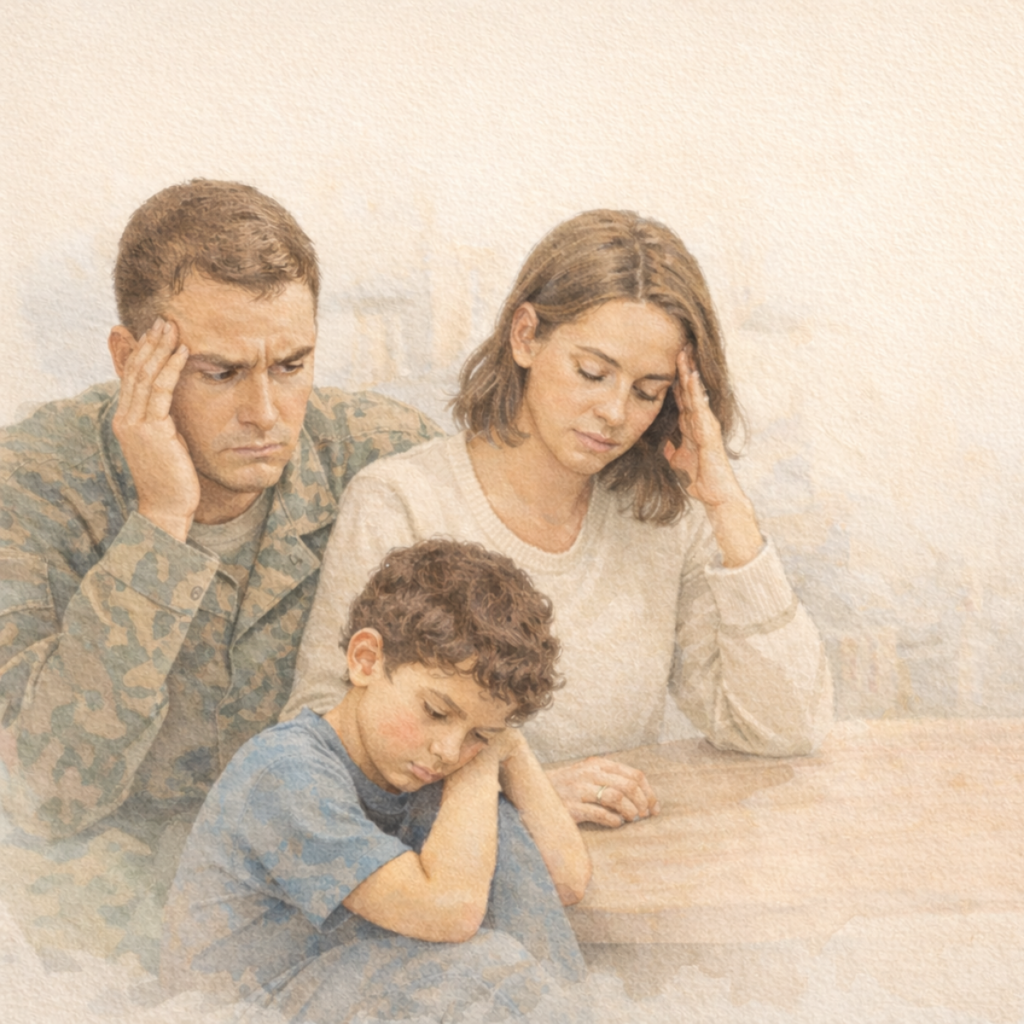
You’re Not Fine: 5 Stress Signals Military Families Overlook
☕ 10 minute read
Quick Takeaway
Military families – active duty and veteran – often miss these 5 early stress signals: irritability, withdrawal, family tension, physical symptoms, and avoidance.
These aren’t failures; they’re your nervous system asking for support. Recognizing them early helps you prevent burnout instead of recovering from it. Download our free worksheet to identify your family’s unique patterns.
What’s In This Article:
• Why Military Families Miss Stress Signals
• Signal #1: Irritability That Feels “Out of Nowhere”
• Signal #2: Withdrawing or “Going Quiet”
• Signal #3: Increased Family Tension
• A Word for Separated, Retired & Veteran Families
• Signal #4: Physical Symptoms You Brush Off
• Signal #5: Avoidance & Shutdown
• Why These Signals Are Easy to Miss
• Download Your Free Stress Signals Worksheet
Military families are some of the most adaptable people in the world – not because life is easy, but because you’ve learned how to adjust, stretch, and recalibrate more times than most people will in a lifetime.
And here’s what most people don’t realize: these patterns don’t automatically stop when active duty ends. Separated, retired, and veteran families carry the same stress signals – sometimes even more intensely as you navigate the transition to civilian life.
But here’s what that resilience costs you: you get so good at “handling it” that you stop noticing the early signs that you’re carrying too much.
I see this constantly in my work with military families – both active duty and veteran. A spouse will reach out during a crisis – after a deployment meltdown, after a PCS move that broke everyone, during a difficult transition to civilian life, after months of solo parenting finally caught up – and say, “I don’t know how I got here.”
But when we trace it back? The signs were there. They just didn’t look like what you expected stress to look like.
Stress rarely shows up as a dramatic moment.
It shows up quietly, subtly, and often in ways you don’t recognize until you’re already overwhelmed.
These are the five most common stress signals military families miss – and how to catch them before they turn into crisis.
1. Irritability That Feels “Out of Nowhere” (But Isn’t)
You snap at your spouse over something small.
You have no patience for the kids’ noise.
You feel angry at everything and everyone – and you don’t even know why.
You think: “Why am I like this? I’m not usually this person.”
Here’s the truth: You’re not angry at your spouse. You’re not annoyed with your kids. You’re not suddenly a short-tempered person.
You’re stretched thin.
For military families – active duty, separated, or retired – irritability often shows up when:
• You’re anticipating a deployment (the countdown anxiety)
• You’re adjusting after reintegration (the recalibration exhaustion)
• You’re navigating transition to civilian life (the identity shift, loss of structure, healthcare changes)
• You’re carrying the invisible load alone (managing everything while your partner is consumed by the mission or struggling with post-service adjustment)
• You’re managing everyone else’s emotions (holding space for your kids’ fears while burying your own)
• Your partner is dealing with service-connected injuries or PTSD (caretaker burnout is real)
This isn’t a character flaw. It’s a capacity signal.
What to do:
Ask yourself: “What’s draining me beneath the surface that I haven’t acknowledged?”
Often, irritability is your nervous system saying: “I’m out of emotional bandwidth, and I need support.”
2. Withdrawing or “Going Quiet” (The Silent Stress Signal)
Many military parents and spouses don’t explode when stressed – they retreat.
You might:
• Cancel plans with friends
• Avoid difficult conversations with your spouse
• Spend more time alone or in your own head
• Feel disconnected from your partner or kids
• Stop asking for help (even when you need it)
This is especially common when you’re trying to stay strong for everyone else. But withdrawal is often your nervous system saying, “I’m overwhelmed and need space.”
What to do:
Notice the pattern: “Am I pulling away because I genuinely need rest, or because I’m overwhelmed and shutting down?”
Rest recharges you. Shutdown isolates you.
Recognizing the difference helps you address the real need.
3. Increased Tension in the Family System (When the Whole House Feels “Off”)
Stress rarely stays with one person – it spreads.
You might notice:
• More arguments over small things
• Shorter fuses across the board
• Kids acting out, melting down, or shutting down more often
• A sense of walking on eggshells at home
• Misunderstandings that escalate quickly
• Feeling like everyone is on edge
This isn’t your fault, and it’s not a sign your family is broken.
Military families live with constant transition: PCS moves, deployments, TDYs, schedule changes, mission pressures. And for separated or retired families, the stress doesn’t end – it just changes form. Civilian transitions, loss of military community, healthcare navigation, identity shifts, and the invisible wounds of service all strain connection. Transitions strain connection. When the whole house feels “off,” that’s a signal, not a failure.
What to do:
Ask: “What’s changing in our environment that might be affecting all of us?”
Common triggers:
• Pre-deployment anxiety
• Reintegration adjustment
• New duty station stress
• IEP/504 challenges at a new school
• Lack of support network in a new place
• Transition from military to civilian life
• Navigating the VA system
• Loss of military identity and community
• Managing service-connected conditions
• Spouse struggling to find employment post-military
Name the stressor together as a family. Sometimes just acknowledging “we’re all adjusting to Dad/Mom being gone” or “this PCS has been really hard” or “we’re all figuring out civilian life together” releases pressure.
💡 Not sure what your family’s stress signals are? Skip to download the free worksheet at the end of this article.

🎖️ A Word for Separated, Retired, and Veteran Families
If you’re reading this post-active duty, you might be thinking: “But we’re not in the military anymore. Why am I still feeling this way?”
Here’s the truth: Military stress doesn’t end when service does.
The patterns you developed over years of military life—hypervigilance, constant adaptation, mission-first mentality, suppressing your needs—don’t just disappear. They’re wired into your nervous system.
Post-Service Stress Signals Often Include:
For Service Members: • Struggling with loss of identity and purpose • Hypervigilance in civilian settings (scanning for threats, difficulty relaxing) • Difficulty with unstructured time • Isolating from civilian friends who “don’t get it” • Irritability when things don’t follow protocol or structure • Grief over loss of military community and brotherhood/sisterhood
For Spouses: • Relief mixed with resentment (you survived military life, but at what cost?) • Frustration that stress continues even without deployments • Navigating new healthcare systems (goodbye Tricare, hello confusing civilian insurance) • Starting over professionally (again) • Managing expectations that “everything should be easier now” • Supporting your partner through PTSD, TBI, or service-connected conditions while your needs remain invisible
For Families: • Kids struggling with the loss of military community and structure • More conflict as family roles shift • No more built-in support systems (Family Readiness Groups, on-base resources) • Navigating VA appointments and disability claims • Financial stress from transition • The weight of “You’re out now, you should be fine”
If this is you: these stress signals are valid. Your stress is real. You’re not being dramatic.
Military-connected stress doesn’t expire when service ends – it just changes shape.
4. Physical Symptoms You Keep Brushing Off (Your Body Knows First)
Your body often speaks before your mind catches up.
Common early stress signals include:
• Fatigue or exhaustion that sleep doesn’t fix
• Headaches or body tension (especially neck, shoulders, jaw)
• Stomach issues or changes in appetite
• Sleep disruption (trouble falling asleep, waking up at 3 AM, vivid dreams)
• Getting sick more often (your immune system is depleted)
You might think: “I’m just tired. It’s just a headache. I probably need more water.”
These aren’t random. They’re stress indicators – especially when paired with military-specific pressures like:
• PCS moves
• Unpredictable schedules or last-minute changes
•Solo parenting during deployment
• Managing neurodivergent kids’ needs alone
• Navigating VA healthcare and disability claims
• Supporting a partner through stressors or mental health needs
• Adjusting to civilian employment stress
• Processing grief from loss of military identity or community
What to do:
Notice patterns: “Is this happening more often than usual? What else is going on in my life right now?”
Your body doesn’t lie. If you’re dismissing physical symptoms, ask yourself what emotional load you’re carrying that you haven’t processed.
5. Avoiding Responsibilities or Feeling “Shut Down” (When Everything Feels Too Heavy)
This one is easy to misinterpret as laziness or lack of motivation – especially in yourself.
But for military families, including separated and retired families – shutdown often happens when:
• You’ve been in survival mode too long
• You’re juggling kids’ needs, school transitions, therapy appointments, IEPs
• You’re managing the household solo while your spouse is deployed or working long hours
• You’re emotionally overloaded but have no outlet
• You’re navigating civilian life after years of military structure
• You’re dealing with VA appointments, disability claims, and medical systems
• You’re supporting a partner through post-service transition or mental health challenges
• You’ve lost your military community and support system
You might:
• Procrastinate on tasks that normally wouldn’t bother you
• Feel paralyzed by simple decisions
• Avoid opening emails or dealing with paperwork
• Feel like you’re moving through mud
This isn’t laziness. It’s nervous system overload.
What to do:
Ask yourself: “What feels too heavy right now, and why?”
Often, what you’re avoiding isn’t the task itself – it’s the emotional weight attached to it. (That IEP meeting, the argument with Tricare, the housing inspection, the friend you’re too tired to text back, the VA appointment you keep rescheduling, the disability claim paperwork that feels overwhelming, the civilian job applications, the conversation about your partner’s drinking or PTSD symptoms.)
Avoidance is not a moral issue. It’s a nervous system issue.
Why These Stress Signals Are So Easy to Miss
Because you’re used to functioning under pressure.
Because you normalize what other families would call “a lot.”
Because you’ve learned to adapt faster than you can process.
Because military life doesn’t always give you space to slow down.
Because even after service ends, you’re still carrying the patterns, the hypervigilance, the expectation to “be strong.”
Because civilian life doesn’t understand what you’ve been through or what you’re still navigating.
But here’s the truth:
Early recognition is powerful.
It helps you prevent burnout instead of recovering from it.
It lets you adjust your capacity before you hit crisis.
It gives you permission to care for yourself before you’re depleted.
Ready to Identify Your Family’s Unique Stress Signals?
I created a free, fillable worksheet to help you do exactly that:
Military Family Stress Signals: Early Warning System
This gentle, shame-free tool helps you:
✅ Identify your family’s early stress patterns
✅ Recognize military-specific stressors (deployment, PCS, solo parenting, post-service transition)
✅ Understand neurodivergent amplifiers (IEPs, sensory needs, advocacy burnout)
✅ Create a personalized action plan before overwhelm hits
Perfect for active duty, separated, retired, and veteran military families.
This is the kind of support military families deserve – clear, compassionate, and practical.
You’re Not Supposed to Catch Everything Alone
You’re not supposed to carry every transition without support.
You’re not supposed to wait until you’re overwhelmed to ask for help.
You’re not supposed to be the strong one all the time.
Stress signals aren’t warnings that you’re failing.
They’re invitations to care for yourself sooner.
Recognizing them early doesn’t mean you’re weak.
It means you’re wise.
Did you miss the Capacity Blog articles? Start with Who Gets Your Diluted Version
Now Available: Capacity-Based Realistic Goal Setting Workbook
Let’s Connect
Email: hello@mindmental.co
Newsletter: Now Available– Sign-up below
Blog: New posts weekly
ABOUT MINDMENTAL
We provide trauma-informed resources and tools for military families – active duty, separated, retired, and veteran – navigating the unique pressures of military life and post-service transition, especially those with neurodivergent children. Because capacity should always come before expectation.
Important Note: I am not a licensed therapist or counselor and I do not provide clinical mental health services. Mindmental offers educational resources, organizational tools, and community support based on professional experience and lived expertise. For clinical care, please contact a licensed provider.