
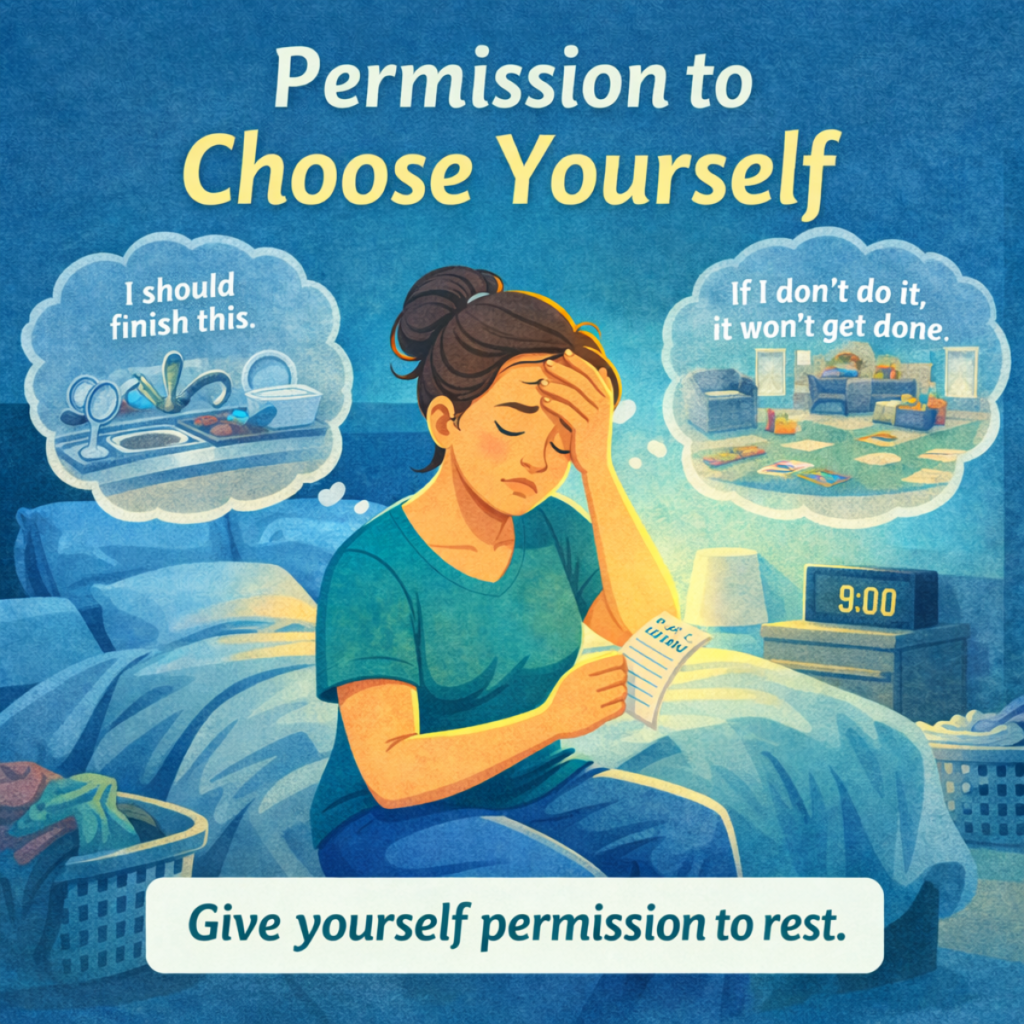
Permission to Choose Yourself
You’ve spent all day meeting everyone else’s needs — your spouse, your kids, your job, the house. And now it’s 9 PM, and somehow you’re still the one holding everything together.
You look around and feel that familiar mix of exhaustion and resentment. Your spouse is already winding down. The house is still a mess. And you’re stuck in the same loop:
“I should finish this.”
“I can’t rest yet.”
“If I don’t do it, it won’t get done.”
You keep waiting for permission – permission to stop, to rest, to let things wait. But the permission you’re waiting for isn’t coming from anyone else.
It has to come from you.
Why External Permission Never Feels Like Enough
People tell you, “Just leave it,” or “You deserve a break,” but it doesn’t land. Because even when you try to rest, you’re still:
- anticipating the next request
- tracking what still needs to be done
- calculating whether this break will cost you later
Your breaks aren’t really breaks. They’re pauses before the next responsibility.
And that’s why someone else’s permission never feels real – because you’re still operating inside the same rules:
Rest must be earned.
Everything falls on me.
If I stop, something will slip.
Those rules aren’t moral truths. They’re survival strategies you learned in systems that demanded too much and supported too little.
The Internal Rules You Didn’t Choose
If you’re a military spouse, a caregiver, a veteran, or the default parent, you’ve absorbed messages like:
- “Mission first.”
- “Good parents sacrifice.”
- “If I don’t do it, it won’t get done.”
- “Rest comes after everything else.”
These beliefs feel like responsibility, but they function like chains. They keep you from recognizing that your needs matter now, not after the house is clean or the kids are settled or the mission is complete.
Why This Isn’t Easier (And Why It’s Not Your Fault)
You’re not struggling because you’re disorganized or dramatic or “not as strong” as other people.
You’re struggling because:
- You became the default parent or partner.
- Your breaks aren’t protected.
- The mental load never transfers.
- You’re managing invisible work no one else sees.
- You’re operating inside systems that weren’t built for your reality.
It’s not easier because the load isn’t equal – and that’s not your failure.
What Self‑Permission Actually Looks Like
Self‑permission isn’t a feeling. It’s a choice – one that feels uncomfortable at first.
It looks like:
- Going to bed even if the dishes aren’t done
- Letting your spouse handle something their way
- Saying “I can’t tonight” without a long explanation
- Closing the door and not answering
- Choosing rest over perfection
It’s not dramatic. It’s not selfish. It’s not abandoning responsibility.
It’s choosing sustainability over burnout.
Why Self‑Permission Feels Wrong (But Isn’t)
You worry that if you stop, everything will fall apart.
Maybe some things will slip – the laundry, the dishes, the schedule. But you won’t. And that matters more.
Because when you’re constantly depleted, you’re not present. You’re not regulated. You’re not able to connect.
Self‑permission isn’t about doing less for others. It’s about finally doing something for yourself.
The Permission That Changes Everything
Of all the permissions you can give yourself, start with this one:
“I give myself permission to be imperfect and still deserving of care.”
Not when everything is done.
Not when everyone else is settled.
Not when you’ve earned it.
Now. As you are.
Because the permission you’ve been waiting for?
It’s already yours.
You just have to claim it.
Want support practicing this?
📥Download the free worksheet: 30 Permission Slips for Exhausted Caregivers
A simple, grounding tool to help you rewrite the rules you never chose.
Let’s Connect
Email: hello@mindmental.co
Newsletter: Sign up to receive monthly newsletter with highlights and resources
Blog: New posts weekly
ABOUT MINDMENTAL
We provide trauma-informed resources and tools for military families—active duty, separated, retired, and veteran—navigating the unique pressures of military life and post-service transition, especially those with neurodivergent children. Because capacity should always come before expectation
Important Note: I am not a licensed therapist or counselor and I do not provide clinical mental health services. Mindmental offers educational resources, organizational tools, and community support based on professional experience and lived expertise. For clinical care, please contact a licensed provider.