
In Part 1, we talked about what makes “coming home” complex for military families. Now: how to support neurodivergent children when you get there.
Holiday gatherings often come with unspoken scripts – how children “should” behave, how quickly gifts “should” be opened, how warmly relatives “should” be greeted. But for neurodivergent children, especially those growing up in military families, these expectations can feel confusing, overwhelming, or simply incompatible with how their brains process the world.
If your child doesn’t fit the traditional holiday expectations, you’re not doing anything wrong. Your child isn’t doing anything wrong. The traditions simply weren’t built with them in mind.
This guide is here to help you rewrite those traditions with compassion, flexibility, and confidence – so your child can experience the holidays in a way that honors who they truly are.
(Missed Part 1? Read Coming Home for the Holidays)
The Gift‑Opening Performance Trap
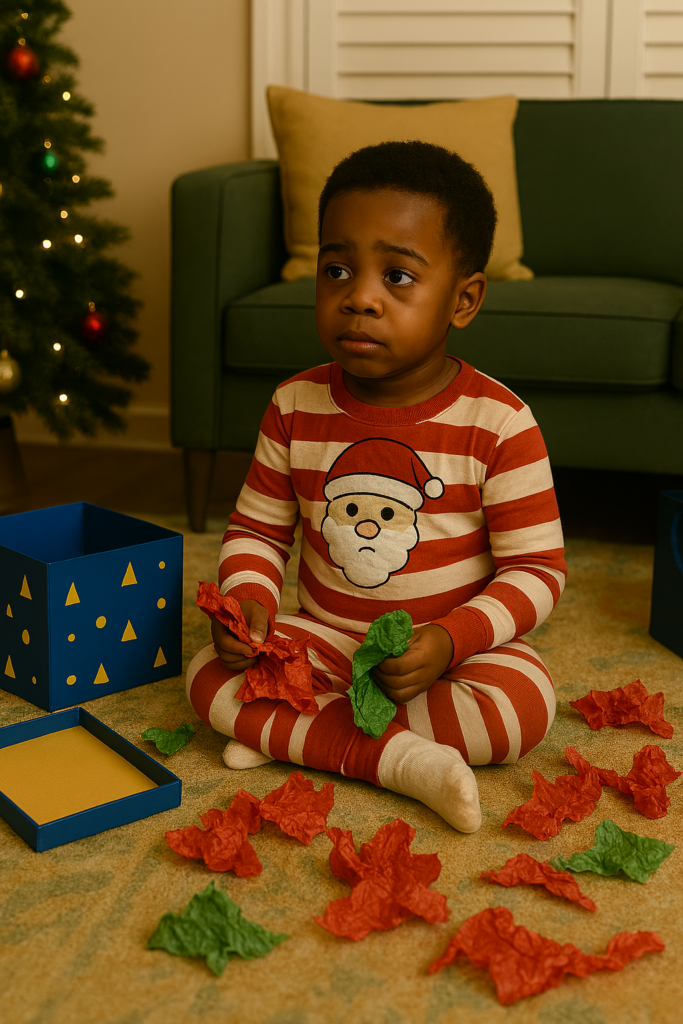
Gift‑opening is often treated like a performance: everyone watching, cameras out, waiting for the “right” reaction. For many neurodivergent children, that level of attention is overwhelming.
And I’ve lived this firsthand.
Before my oldest child was diagnosed, I couldn’t understand why it took him a full week to open his Christmas gifts. He’d unwrap one, wander off, come back hours later, and repeat the cycle. No matter how much we encouraged him to open another gift or reminded him he had more, he was unbothered and took his time. Now, years later, my youngest does the same – opening one gift, examining what others received, playing with wrapping paper, or taking a break on his tablet before returning when he’s ready.
It wasn’t defiance. It wasn’t disinterest. It was regulation.
There is no “right” way to open gifts – only the way that works for your child.

Why It Happens
• Sensory overload from noise, lights, and excitement
• Different atomsphere and ops temp (even they know Christmas is coming, everyone’s moods, scheduling, and expectations are different)
• Pressure to react “appropriately”
• Difficulty shifting attention quickly
• Needing time to process one thing before moving to the next
Supportive Scripts
You can advocate for your child with simple, confident language:
• “_____ prefers to open gifts privately and share their excitement with you later.”
• “We open gifts slowly so everyone stays regulated.”
• “We’re pacing ourselves today – thanks for understanding.”
Alternative Approaches:
• Let your child open one gift at a time throughout the day (or week).
• Allow breaks between gifts for play, quiet, or regulation.
• Save some gifts for later when the environment is calmer.
• Create a quiet gift‑opening corner away from the crowd.
Why “Give Grandma a Hug” Isn’t Always Appropriate
Physical affection is often treated as a holiday requirement. But for many neurodivergent children, unexpected touch can be uncomfortable, dysregulating, or even distressing.
And consent matters – even at Christmas.
What You Can Say
• “We’re teaching ___ to choose how they greet people.”
• “Hugs aren’t comfortable for them, but they’re happy to say hello.”
• “We’re practicing body boundaries – thanks for supporting that.”
Alternative Greetings
Offer options that still feel warm and connected:
• Waves
• High‑fives
• Fist bumps
• Verbal greetings (“Hi Grandma, I’m glad to see you”)
• Showing a toy or drawing as a form of connection
Your child can be polite and loving without physical contact.
Meeting Your Child Where They Are
Holiday gatherings often come with expectations of full participation – games, meals, conversations, group activities. But neurodivergent children may need a different pace.
Flexible Participation Looks Like
• Joining the group for five minutes, then taking a break
• Eating in a quieter room
• Playing independently during loud activities
• Observing before engaging
• Participating in one tradition but skipping another
Forced Engagement Looks Like:
• “You need to stay in here with everyone.”
• “Stop being shy.”
• “You’re being rude – go play with your cousins.”
• “You should be having fun.”
Your child isn’t refusing connection – they’re protecting their nervous system.
The Military Family Layer: When Two Worlds Collide
Neurodivergent children in military families face a unique combination of challenges that civilian relatives may not understand.
Travel Stress Compounds Sensory Needs
- Airports, crowds, long drives, and schedule disruptions
- New environments with unfamiliar smells, sounds, and routines
- Fatigue from transitions and overstimulation
Extended Family May Not Understand Accommodations
- “He’s just being picky.”
- “She needs to toughen up.”
- “We didn’t do all this when you were a kid.”
- “Why can’t they just join in?”
- “You’re letting that child call all the shots.”
- “It’s so sad they don’t know their cousins better.”
These comments often come from misunderstanding, not malice – but they still hurt.
When Distance Meets Difference
Military families face unique judgment around relationships and traditions. I’ve heard relatives express sadness that my children don’t know their cousins “well enough” – without acknowledging that we live states away, that traveling with three children (especially neurodivergent ones) presents real logistical challenges, or that coordinating video calls between kids who’ve never built relationships feels forced and uncomfortable for everyone.
The assumption that closeness should happen automatically, regardless of distance, neurodivergence, or individual personalities, adds another layer of pressure to already complex family dynamics.
Trusting Your Family’s Reality
Military families develop resilience, adaptability, and deep understanding of different needs – including neurodivergent ones. You’ve navigated constant transitions, created stability in unpredictable environments, and learned to recognize when your child is struggling versus thriving.
That insight isn’t just valid – it’s essential. You know your child better than anyone else in that room.
Rewriting Traditions with Compassion
Your child doesn’t need to fit the holiday. The holiday can fit your child.
Here are grounding reminders for the season:
• Slower is not wrong.
• Quiet is not rude.
• Breaks are not disrespectful.
• Different participation is still participation.
• Your child’s comfort matters more than anyone’s expectations.
• Distance doesn’t diminish love.
And when relatives push back, you can stand firmly in the truth:
Your child deserves to experience the holidays in a way that feels safe, joyful, and authentic – not performative.
You’re Not Alone
If your child opens gifts slowly, avoids hugs, wanders between activities, or needs breaks during gatherings, you’re in good company. Many neurodivergent children – including mine – thrive when they’re given space, time, and autonomy.
The holidays can be beautiful, but only when we make room for every child’s way of being.
Resources
Crisis Support:
- 988 Suicide & Crisis Lifeline – Call or text 988
- Veterans Crisis Line – Call 988, press 1
- Crisis Text Line – Text HOME to 741741
Military Family & Neurodivergent Support:
- Military OneSource – 800-342-9647 | MilitaryOneSource.mil
Free 24/7 support, counseling, and resources for all military families - EFMP (Exceptional Family Member Program) – Contact through your installation
Support coordination for families with special medical or educational needs - Autism Society Military Initiative – Autism-Society.org/military
Resources specifically for military families with autistic members - National Military Family Association – MilitaryFamily.org
Advocacy, support programs, and family resources
Previous in Series:
Part 1: Coming “Home” for the Holidays
What’s helping your family navigate holiday gatherings?
Share in the comments – your strategies might help another parent.
💙 This is hard work. You’re doing it anyway.
📧 Want more resources for military families? Newsletter launching January 2025.
Email: hello@mindmental.co